When the Reservoir Sends More Than Oil
Offshore oil and gas wells are engineered to deliver one thing: hydrocarbons from the reservoir to surface, consistently and safely, over a production life that typically spans years or decades. Every element of the completion design exists to serve that objective. But reservoirs do not always cooperate. Some formations, particularly the weakly consolidated sands that host large portions of deepwater production worldwide, have a tendency to do something the completion design must account for from the very beginning. They produce not just oil and gas, but the rock itself.
Sand production is one of the most operationally consequential phenomena in upstream production. It can erode equipment, plug completions, impair inflow, compromise well integrity, and in severe cases, end the productive life of a well prematurely. On land, these consequences are serious. Offshore, where intervention costs are orders of magnitude higher and logistics are substantially more complex, they become critical.
Sand control is the discipline that addresses this problem. It is not a peripheral detail in completion engineering. In many deepwater environments, it is the central challenge around which the entire completion strategy is built.
This article explains what sand production is, why it happens, how the industry controls it, and why getting sand control right matters especially in offshore wells.
Not Just Particles in the Flow
What Is Sand Production?
Sand production, in plain terms, is the migration of solid particles from the reservoir rock into the wellbore during production. These particles are primarily fine-grained silica grains and other formation material that have been detached from the rock matrix and carried into the flow stream by producing fluids.
It is worth clarifying that sand production is not universal. Many reservoirs produce cleanly without any sand management concern. Whether a formation is prone to sand production depends on the nature of the rock itself, the conditions under which it is produced, and how those conditions evolve over the life of the well.
When sand production does occur, it rarely announces itself dramatically at first. In many cases, it begins as a low-level nuisance and progressively worsens as the well matures, drawdown increases, or reservoir pressure declines. The gradual nature of that progression is one of the reasons it can be underestimated until the damage is already done.
Weak Rock, High Drawdown, and the Physics of Grain Detachment
Why Some Formations Produce Sand
Three factors converge to make a formation susceptible to sand production.
Rock strength and cementation. Not all sandstone is created equal. Some formations are well-consolidated, meaning the individual grains are strongly bonded together by natural cement material deposited over geological time. Others, particularly younger formations and deepwater turbidite sands, are weakly consolidated or unconsolidated. In these rocks, the bonding between grains is poor. When fluid flows through the pore network under production-induced pressure gradients, the hydrodynamic drag forces acting on individual grains can exceed the cohesive forces holding the rock together. The result is grain detachment and mobilization.
Drawdown. Drawdown is the pressure difference between the reservoir and the wellbore that drives fluid flow. The larger that differential, the faster fluids move through the pore space, and the greater the drag force on formation grains. Producing a weakly consolidated reservoir at high drawdown is, in simplified terms, comparable to pouring water rapidly through a sandcastle. The structure holds at a trickle. It does not hold under a torrent.
Reservoir depletion over time. As reservoir pressure declines over the producing life of a field, the effective stress carried by the rock framework increases. A formation that was marginally stable at initial reservoir pressure may become increasingly prone to failure as the field matures. Sand production risk, in many cases, does not decrease with time. It increases.
The Offshore Multiplier: When Sand Damage Is Hard to Undo
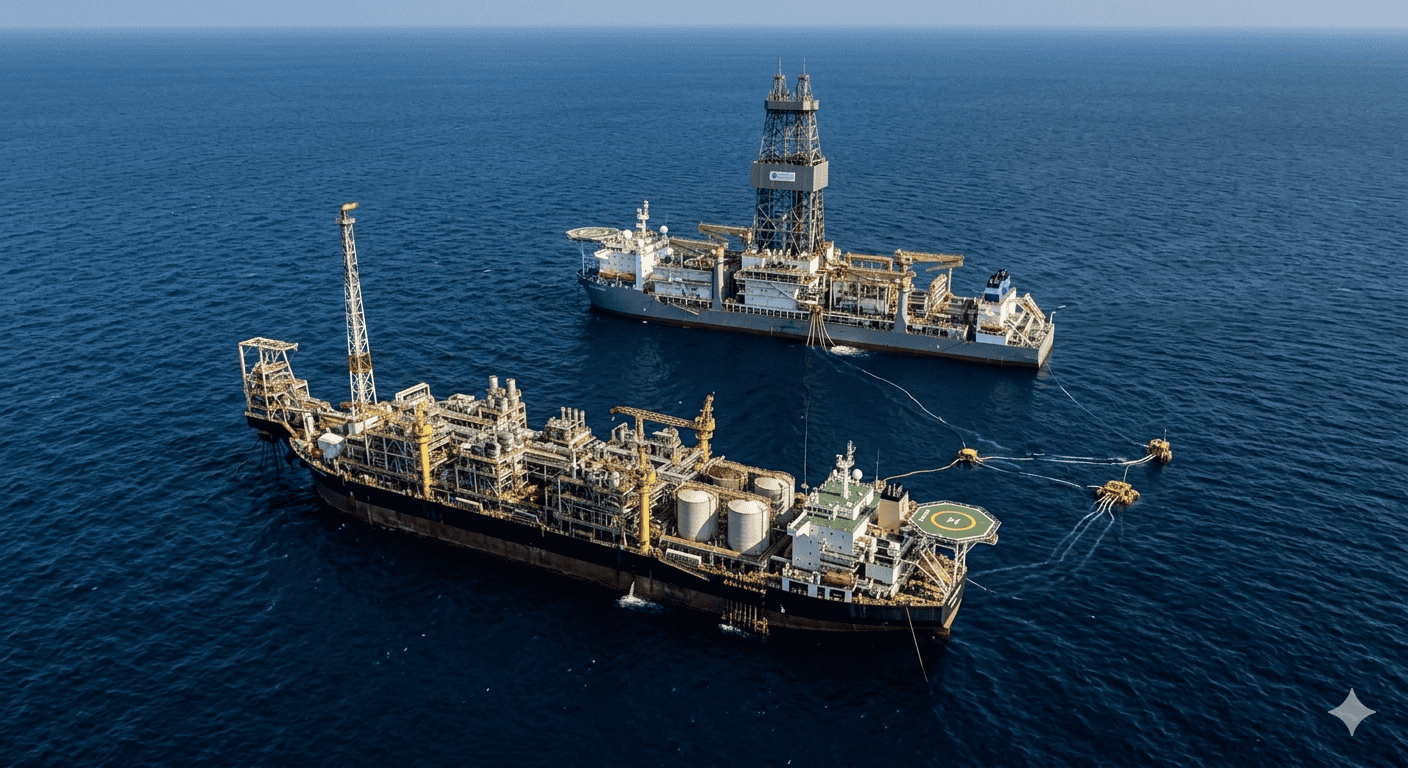
Why Sand Production Is Especially Dangerous Offshore
In any production environment, sand entering the wellbore and flow system is damaging. But the consequences are not equal across all operating contexts. Offshore, and particularly in deepwater and subsea environments, the consequences of uncontrolled sand production are substantially more severe.
Sand-laden fluids are abrasive. They erode downhole completion equipment, including tubing, subsurface safety valves, flow control devices, and chokes. The erosion is progressive and cumulative. Surface and topsides equipment, including separators, flowlines, manifolds, and riser systems, are equally vulnerable. Over time, abrasion degrades wall thickness, increases leak risk, and can force unplanned shutdowns for integrity assessment and repair.
Beyond erosion, accumulated sand in the wellbore presents a separate problem. Sand settling out of the flow stream can bridge across perforations, partially or completely blocking inflow from the reservoir. In more severe cases, sand accumulation in the tubing string can cause a well to die entirely, an event that in some deepwater configurations may be extremely difficult to remediate without full well intervention.
There is also a safety and environmental dimension that should not be overlooked. Erosion-related failures in offshore systems, particularly in high-pressure, high-temperature environments, carry integrity risks that extend well beyond production loss.
The factor that makes all of these consequences especially significant offshore is the cost and complexity of intervention. Prevention is not merely preferred. In many deepwater cases, it is the only economically rational approach.
On a land well, a workover rig can be mobilized in days and at relatively modest cost. On an offshore platform, and particularly on a subsea development, well intervention requires specialized equipment, significant vessel or rig mobilization costs, and careful operational planning. The barriers to remediation are high enough that in many cases, getting sand control right from the beginning is simply the most defensible engineering decision available.
Five Approaches, One Common Goal
The Main Sand Control Methods
Sand control is not a single technique. It is a family of engineering approaches, each suited to different formation conditions, well geometries, and production requirements. No method is universally superior. Method selection depends on a combination of formation characteristics, expected production conditions, completion design, and economics. The shared objective across all methods is the same: allow hydrocarbons to flow into the wellbore, while preventing formation particles from following them.
1. Drawdown Management
The simplest approach to sand control is also the least hardware-intensive: limit the pressure differential across the reservoir face to keep flow velocities below the threshold at which grains are mobilized. This is a rate-based strategy. By producing below a critical drawdown level, the engineer avoids creating the hydrodynamic conditions necessary for grain detachment.
The advantages of drawdown management are its simplicity and its absence of mechanical risk. No additional completion hardware is required. In borderline cases, or where formation strength is only marginally insufficient, it can be an effective first-line measure.
Its limitations are equally clear. It sacrifices production rate. It is difficult to sustain reliably as reservoir conditions change. And as a standalone strategy, it provides no protection if sand production occurs despite rate restrictions. In practice, drawdown management is more often used as a supplementary measure alongside mechanical sand control methods rather than as a primary solution on its own.
2. Standalone Screens (SAS)
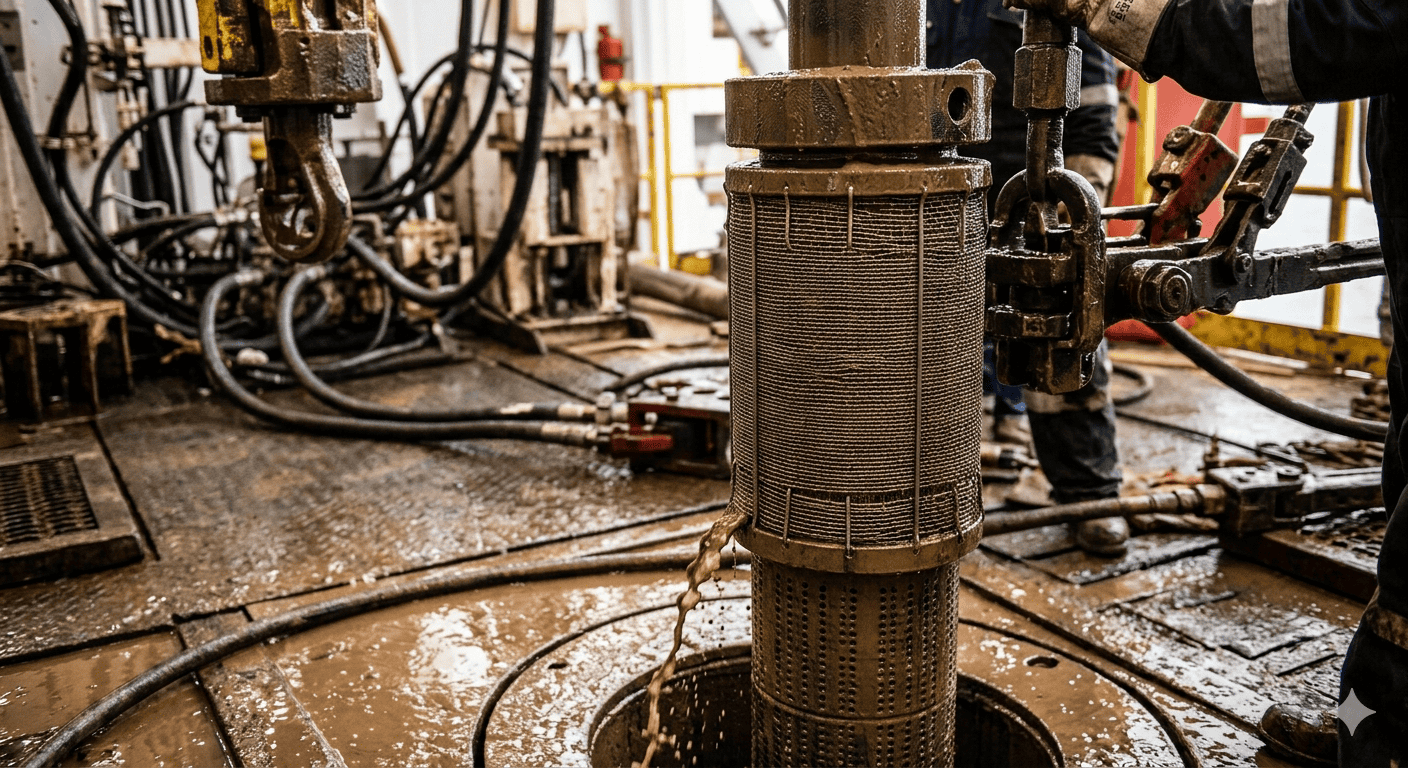
A standalone screen is a filter element run as part of the completion string, positioned across the producing interval. The screen allows reservoir fluids to flow through while blocking the passage of formation particles above a certain size. The critical design parameter is the slot width or pore opening, which must be carefully calibrated to the formation’s grain size distribution.
Screens perform well in formations with coarser, well-sorted grains. In poorly sorted sands, or in formations with significant clay or fines content, they are more vulnerable. Fine particles can migrate through the screen, and the accumulation of fines can progressively plug the screen face, restricting inflow and increasing pressure drop across the completion.
Screens are also susceptible to mechanical damage during installation, particularly in highly deviated or horizontal wells where the assembly must navigate significant doglegs. Erosion of the screen itself can occur at high flow velocities, particularly at points where flow converges.
3. Gravel Packs
A gravel pack is the most widely used sand control method for offshore completions. The concept is straightforward in principle, though demanding in execution. A carefully sized gravel, calibrated to the formation’s grain size distribution, is placed in the annular space between the screen and the formation face. The gravel acts as a filter medium. Formation sand is too coarse to pass through the gravel pack. Reservoir fluids are not.
The sizing of the gravel is governed by established design criteria that relate gravel grain diameter to formation grain diameter. The relationship is well-defined from decades of field experience. Get the sizing right, and the gravel pack provides a stable, permeable barrier against sand production while allowing fluid flow to continue. Get it wrong, and either formation sand passes through or the pack itself becomes a restriction.
When properly designed and executed, gravel packs are robust and have a long track record in deepwater completions. Their main vulnerability is incomplete placement. If the gravel does not fill the annular space uniformly, voids or channels in the pack can allow formation sand to bypass the filter entirely. This can occur due to premature dehydration of the carrier fluid, formation instability during placement, or wellbore geometry that makes uniform packing difficult to achieve.
4. Frac Packs
A frac pack combines hydraulic fracturing with gravel packing in a single integrated operation. A hydraulic fracture is initiated and propagated into the formation, then propped with gravel-like proppant material. As the treatment concludes, the near-wellbore annulus is simultaneously packed in the conventional manner.
This dual function makes frac packs particularly well-suited to specific circumstances. In formations with near-wellbore damage that reduces inflow, the hydraulic fracture bypasses the damaged zone and establishes a high-conductivity pathway into the undamaged reservoir. In lower-permeability formations where conventional gravel packs would not provide sufficient productivity improvement, the fracture creates the inflow enhancement the completion requires. The gravel packing component then ensures the sand control objective is also met.
Frac packs are more operationally complex than conventional gravel packs and correspondingly more expensive. They require precise pressure management, more sophisticated fluid systems, and careful fracture geometry design. In the right formation conditions, however, they can simultaneously solve both the sand control problem and the productivity problem, which makes them an important tool in the offshore completion engineer’s portfolio.
5. Chemical Consolidation
Chemical consolidation works differently from the other methods. Rather than filtering formation sand, it attempts to improve the rock’s inherent resistance to grain detachment. A consolidating agent, typically a resin-based system, is injected into the near-wellbore formation. The resin coats and bonds the grains together, increasing the mechanical strength of the rock matrix without fully plugging the pore space, so that fluids can still flow through.
Chemical consolidation is more limited in both scope and reliability than mechanical methods. The treatment depth from the wellbore is typically modest, and the durability of the resin over years of production can vary depending on formation conditions and fluid compatibility. For these reasons, it is more commonly applied as a remedial measure, when sand breakthrough occurs in a well not initially equipped with mechanical sand control, rather than as a primary completion strategy. In select circumstances, it can serve as a useful supplementary or interim measure.
The Decision Is Never Made in a Vacuum
How Engineers Choose a Sand Control Method
Selecting the appropriate sand control method is not a lookup exercise. It is an integrated engineering evaluation that draws on multiple data sources and requires careful judgment.
The key inputs to that evaluation typically include:
- Formation grain size distribution from sieve analysis of core samples or sidewall cores, which directly informs gravel sizing and screen selection.
- Rock mechanical strength data, derived from laboratory testing on core material or geomechanical analysis of offset well data, which determines how susceptible the formation is to shear and grain detachment under production conditions.
- Expected production rates and drawdown requirements, which must be reconciled with formation stability data. A formation that is borderline stable at low drawdown may be clearly unstable at the rates the well needs to deliver to be commercially viable.
- Wellbore geometry, particularly deviation and azimuth, which affects what equipment can be physically placed downhole and how reliably it can be installed.
- Completion architecture at the field level, including whether the development is platform-based or subsea, which affects what intervention capability exists if a sand control completion underperforms.
In practice, the sand control design process typically involves a dedicated risk assessment phase supported by laboratory analysis, geomechanical modelling, and review of offset well performance. That investment in evaluation before the completion is run is what allows engineers to make a defensible, well-reasoned selection rather than a default one.
Every Sand Control Decision Has a Productivity Cost
The Productivity Versus Protection Trade-off
One of the most important things to understand about sand control is that protection comes at a price. Every mechanical sand control method introduces additional flow resistance in the completion. Screens, gravel packs, and frac packs all impose some degree of near-wellbore pressure drop that would not exist without sand control hardware.
This creates a genuine engineering tension. The completion that provides the most robust sand exclusion may not be the one that delivers the highest production rate. The completion that maximizes inflow may expose the well to unacceptable sand production risk. The engineer’s task is to find a design that sits at a defensible point in that trade-off space: adequate protection without unnecessary productivity sacrifice.
A sand control design that imposes excessive restriction leaves productivity on the table. A design that fails requires costly intervention. Both outcomes have real economic weight offshore.
In offshore wells, this tension is particularly pronounced. These wells are expensive to drill and complete, and they are expected to carry significant production targets over their lives. Understanding and managing the productivity versus protection trade-off is central to sound completion engineering in any sand-prone offshore environment.
When Execution Falls Short of Design
Installation Challenges and Failure Modes
A well-designed sand control completion can still fail if it is not executed with precision. Several installation-related failure modes are worth understanding.
Incomplete gravel pack placement is among the most consequential. If the gravel does not fill the annular space uniformly across the producing interval, the resulting voids create pathways through which formation sand can bypass the pack entirely. A completion that appears to have been successfully installed may perform adequately for some time, then experience sand breakthrough as production conditions shift and the void structure is exposed to higher flow velocity.
Screen damage during run-in is a recognized risk, particularly in wells with high angles or significant doglegs. A screen that arrives at depth with a torn or deformed filter element provides uncertain protection at best.
Long or heterogeneous producing intervals add complexity. In a formation that varies in grain size or strength along the interval, a single gravel size or screen specification may not be equally effective at every point. Managing that heterogeneity in the placement operation requires careful design and execution discipline.
These realities reinforce a point that is easily overlooked: design quality and execution quality are both necessary. A technically sound design that is poorly executed in the field provides far less protection than the design intended. In offshore environments, where the opportunity to remediate execution problems is limited and expensive, that distinction matters considerably.
The True Cost of Getting It Wrong Offshore
Why Offshore Makes Prevention Non-Negotiable
The case for rigorous sand control design comes into clearest focus when you consider what remediation actually looks like in an offshore environment.
On a land well, sand-related problems can often be addressed through a workover campaign that, while disruptive, is logistically straightforward and relatively affordable. A rig can be mobilized, the wellbore can be cleaned out, a new sand control completion can be installed, and the well can be returned to production within a commercially acceptable timeframe.
Offshore, none of those assumptions hold in the same way. A platform workover requires rig time that is costly and must be scheduled against competing priorities. A subsea intervention, depending on well configuration and water depth, may require specialized equipment, a dedicated intervention vessel, and extensive pre-job engineering. The cost of a single subsea workover can reach figures that dwarf the original completion cost. The production deferment during that intervention adds further economic weight.
In some deepwater subsea configurations, certain types of completion failure may be difficult or effectively impossible to fully remediate without major well intervention. The implication is that the standard applied to sand control design for an offshore well should be commensurately higher than for a land well.
That reality should inform not only the design of the sand control completion but also the investment in pre-completion characterization. Core analysis, laboratory testing, and geomechanical evaluation are not overhead costs. They are the technical foundation that makes sound sand control design possible.
Sand Control Is a Long Game
Conclusion
Sand control occupies a relatively quiet corner of the technical conversation about offshore production. It lacks the visibility of reservoir stimulation, the complexity of subsurface imaging, or the scale of deepwater infrastructure design. But its consequences, both when it works and when it does not, are felt in production performance, equipment integrity, operational continuity, and long-term well economics in ways that are anything but quiet.
A well that is producing sand is paying a slow tax. On equipment. On completion integrity. On surface systems. On intervention liability. The pace of that erosion can be gradual enough that its full weight is not apparent until the moment a failure makes it undeniable.
The core insight is straightforward. Sand control is not a one-time completion task that can be managed with a standard specification and minimal analysis. It is a design philosophy that reflects how seriously an operator takes the long-term health of the well. In offshore environments, where the cost of getting it wrong is exceptional, that philosophy is not optional. It is what separates wells that sustain commercial production through their intended lives from wells that do not.
Join the Conversation
Which sand control method would you like explored in more depth? Drop a comment below. If there is enough interest, the next article will go further into the practical comparison between standalone screens, gravel packs, and frac packs in offshore completion contexts, including how engineers evaluate them against each other when the formation data is ambiguous.