Why We Drill Sideways: The Engineering Logic Behind Horizontal Wells
12 MIN READTVD: 3,600m MDApr 20, 2026By Kleider Coxe, PE
In virtually every major producing basin on earth such as the North Sea, the Arabian Gulf, the pre-salt offshore Brazil, the tight carbonates of the Middle East, the shale plays of Argentina’s Vaca Muerta, the majority of new development wells are now drilled horizontally.
Not deviated. Not slightly angled. Horizontal, turning deliberately sideways through kilometers of solid rock, navigating geological formations thinner than a two-story building, landing a drill bit within meters of a target plotted on a map before a single meter of hole was drilled.
To anyone outside the industry, this sounds like engineering fiction. To anyone inside it, it sounds like Tuesday.
But here is what surprises even many petroleum engineers when they stop to think about it: horizontal drilling is not a modern invention born from digital technology and sophisticated software. The concept is over a century old. The first true horizontal well, deliberately planned and executed as such, was drilled near Texon, Texas in 1929.
So why did it take until the 1980s and 1990s to become the dominant global drilling paradigm? And why, once it did, did it fundamentally restructure the energy industry worldwide?
The answer lies in a geological reality that vertical wells were never very good at solving.
The Problem with Drilling Straight Down
When most people picture an underground oil reservoir, they imagine something like a vast underground lake: a dark, cavernous space filled with crude oil, waiting to be tapped. Drill a hole down to it, and the oil flows up.
This picture is almost entirely wrong.
Oil and gas do not exist in underground caves or lakes. They exist in the microscopic pore spaces between grains of rock such as sandstone, limestone, and dolomite. Imagine a sponge made of stone, saturated with hydrocarbons instead of water. The oil is not free-flowing in open space; it is trapped within the rock itself, and it can only move if the rock allows it to.
This is where the geometry of a vertical well creates a fundamental problem.
Most petroleum reservoirs are not thick, uniform, underground spheres. They are thin horizontal layers — geological formations deposited over millions of years, often measuring just a few meters to a few tens of meters in thickness, but extending laterally for kilometers in every direction. Think of it less like a ball and more like a pancake. A very thin, very wide pancake, buried thousands of meters underground.
When you drill a vertical well through a 10-metre thick reservoir, your wellbore contacts approximately 10 meters of productive rock. You punch through it like a needle through a sheet of paper, meaning fast entry, and fast exit. The well produces, but it is only ever drawing from the rock immediately surrounding those 10 meters of vertical wellbore.
Now imagine, instead of punching through that paper sheet from above, you thread the needle sideways running it horizontally through the paper for 1,500 meters, 2,000 meters, sometimes 3,000 meters or more.
That is horizontal drilling. And that simple geometric shift changes everything.
What Horizontal Drilling Actually Achieves
The core benefit is reservoir contact, which is the total length of wellbore exposed to productive rock.
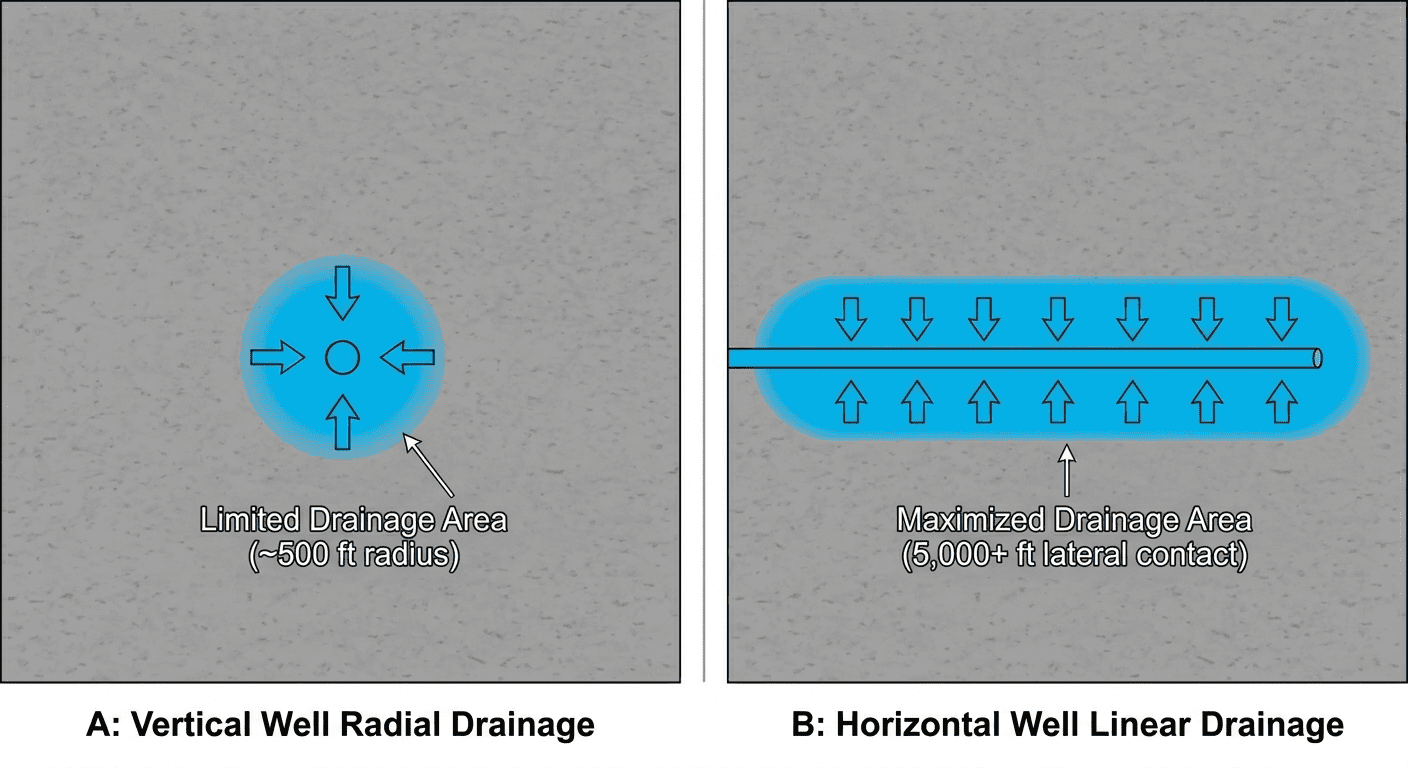
A vertical well in a 15-metre thick reservoir has 15 meters of reservoir contact. A horizontal well in the same reservoir, with a 2,000-metre lateral section, has 2,000 meters of contact. That is more than 130 times the exposure from a single wellbore, at a fraction of the cost of drilling 130 separate vertical wells.
Vertical wells drain a limited radial area; horizontal wells create a long linear drainage path through the reservoir.
This matters for two reasons that feed directly into production rates and project economics.
First, flow rate. Hydrocarbons flow from reservoir rock into a wellbore along the pressure gradient created by the difference between reservoir pressure and wellbore pressure. The more contact area you have, the more pathways you create for that flow. A horizontal well in the right reservoir can produce at rates that would be physically impossible from a vertical well in the same formation not because the rock changed, but because you have exposed far more of it.
Second, recovery factor. A vertical well drains a roughly cylindrical volume of rock around the wellbore. A horizontal well drains a much larger rectangular slab. In a reservoir where the rock has low natural permeability, meaning hydrocarbons struggle to flow through it without help, a vertical well may only ever drain a small radius of rock before pressure declines to uneconomic levels. A horizontal well, by threading through the formation, contacts rock that a vertical well could never reach economically.
This is why horizontal drilling did not just improve existing oil fields. It unlocked entirely new categories of reservoir, specifically, the tight and unconventional formations that now account for a growing share of global production, and the thin-bedded conventional reservoirs that vertical wells could never drain efficiently.
A Global Revolution, Not a Regional One
The popular narrative often frames horizontal drilling as a North American story. It is far bigger than that.
In the North Sea, operators have used extended reach horizontal wells for decades to drain reservoirs from fixed platforms reaching out 8, 10, even 12 kilometers from a single surface location to access reserves that would otherwise require additional infrastructure costing hundreds of millions of dollars. Equinor’s operations on the Norwegian Continental Shelf, BP’s work in the UK sector, Shell’s development of complex thin-bedded reservoirs, horizontal drilling is embedded in the DNA of North Sea field development.
In the Middle East, Saudi Aramco has applied horizontal drilling extensively across the world’s largest conventional fields. Ghawar, the single largest oil field ever discovered, uses horizontal wells to manage reservoir pressure, control water influx and sustain production rates in a carbonate reservoir that has been producing for over seventy years. In tight carbonate plays across the Gulf region, horizontal drilling combined with stimulation is opening resources that conventional vertical development could not access economically.
In South America, Argentina’s Vaca Muerta formation, one of the largest unconventional shale plays outside North America, has seen billions of dollars of investment from operators including YPF, Shell, TotalEnergies and ExxonMobil, all built on horizontal drilling technology. Brazil’s pre-salt offshore fields, though a different geological context, use highly deviated and horizontal wells to maximize drainage from carbonate reservoirs beneath kilometers of salt.
In West Africa, deepwater operators in Angola, Nigeria and Senegal routinely drill horizontal and high-angle wells to maximize production from turbidite sandstone reservoirs, thin, laterally extensive formations where a vertical well would be almost useless.
In China, the Sichuan and Tarim basins have seen significant horizontal drilling programs targeting both conventional and unconventional gas resources, with national operators increasingly applying the technology at industrial scale.
Horizontal drilling is not a regional technique that spread outward from one market. It is a universal engineering response to a universal geological reality: most reservoirs are wider than they are tall, and a wellbore that respects that geometry will always outperform one that ignores it.
How You Actually Turn a Drill Bit Sideways
This is the part that engineers find endlessly fascinating and everyone else finds mildly implausible. How, exactly, do you steer a drill bit through kilometers of solid rock with sufficient precision to land inside a geological target that may be only 5 meters thick?
The short answer is: very carefully, and with a remarkable collection of tools.
Geological modeling and seismic interpretation establish where the target formation sits, its depth, its dip, its lateral extent, its thickness. This data is used to design what drillers call the well trajectory, the planned 3D path from surface to true vertical depth and final target depth, specifying exactly where the wellbore needs to be at every point along its length.
The well is then drilled in distinct sections. The first section is typically vertical, drilled straight down through the shallow formations above the target. This is called the vertical section. Then comes the build section, the curve where the wellbore transitions from vertical to horizontal. This curve is characterized by its build rate, typically expressed in degrees per 30 meters. A build rate of 6°/30m means the wellbore angle increases by 6 degrees for every 30 meters drilled producing a smooth curve that takes roughly 250 meters to transition from vertical to horizontal.
Finally, once the wellbore reaches the target angle, often close to 90°, but not always exactly, it enters the lateral section. This is the horizontal run through the productive formation that is the whole point of the exercise.
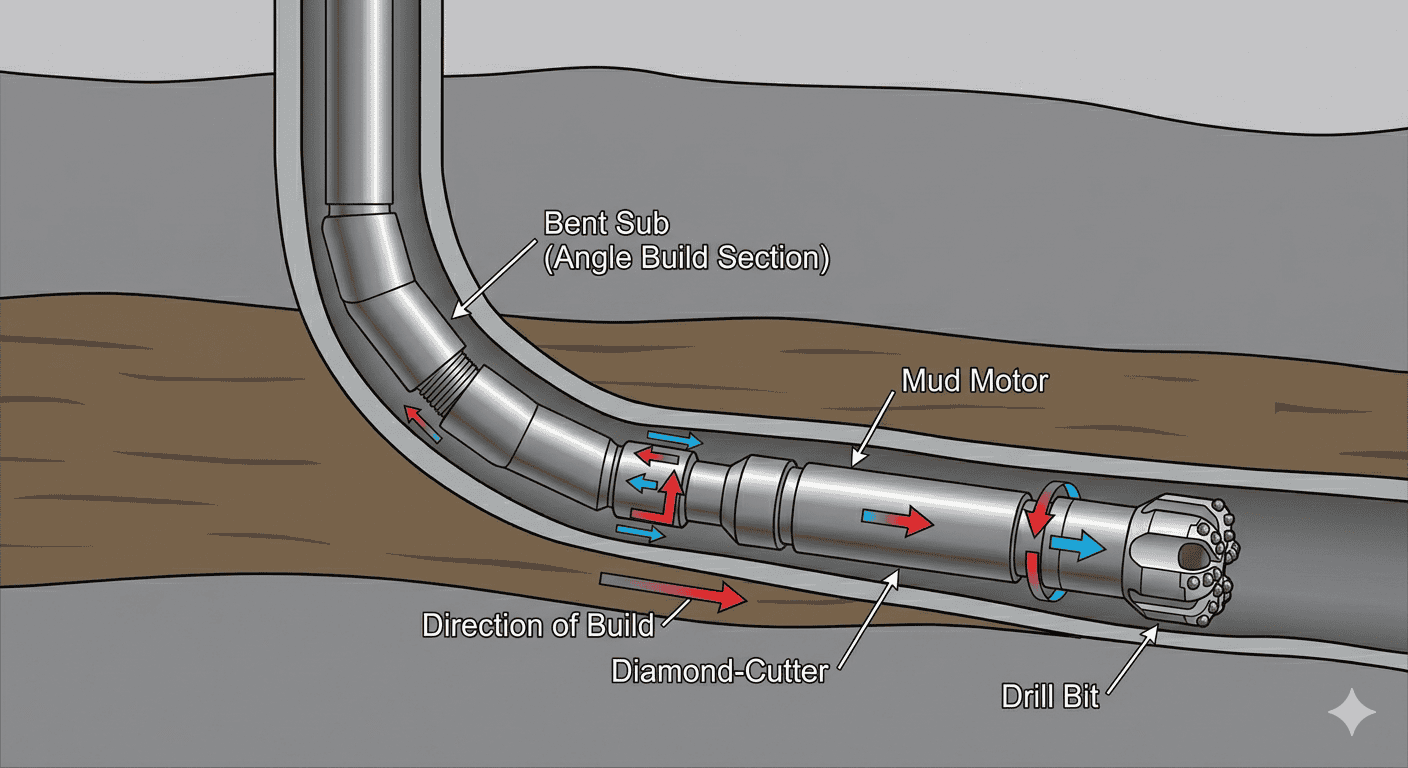
The build section turns the wellbore from vertical toward horizontal, using steerable tools in the bottomhole assembly.
The steering is achieved using a downhole motor or a rotary steerable system in the bottomhole assembly (BHA), the collection of tools immediately above the drill bit. The motor uses drilling fluid pumped down through the drill string to rotate the bit independently of the string itself. By orienting the motor’s bent housing in a specific direction, the driller steers the bit along the planned trajectory.
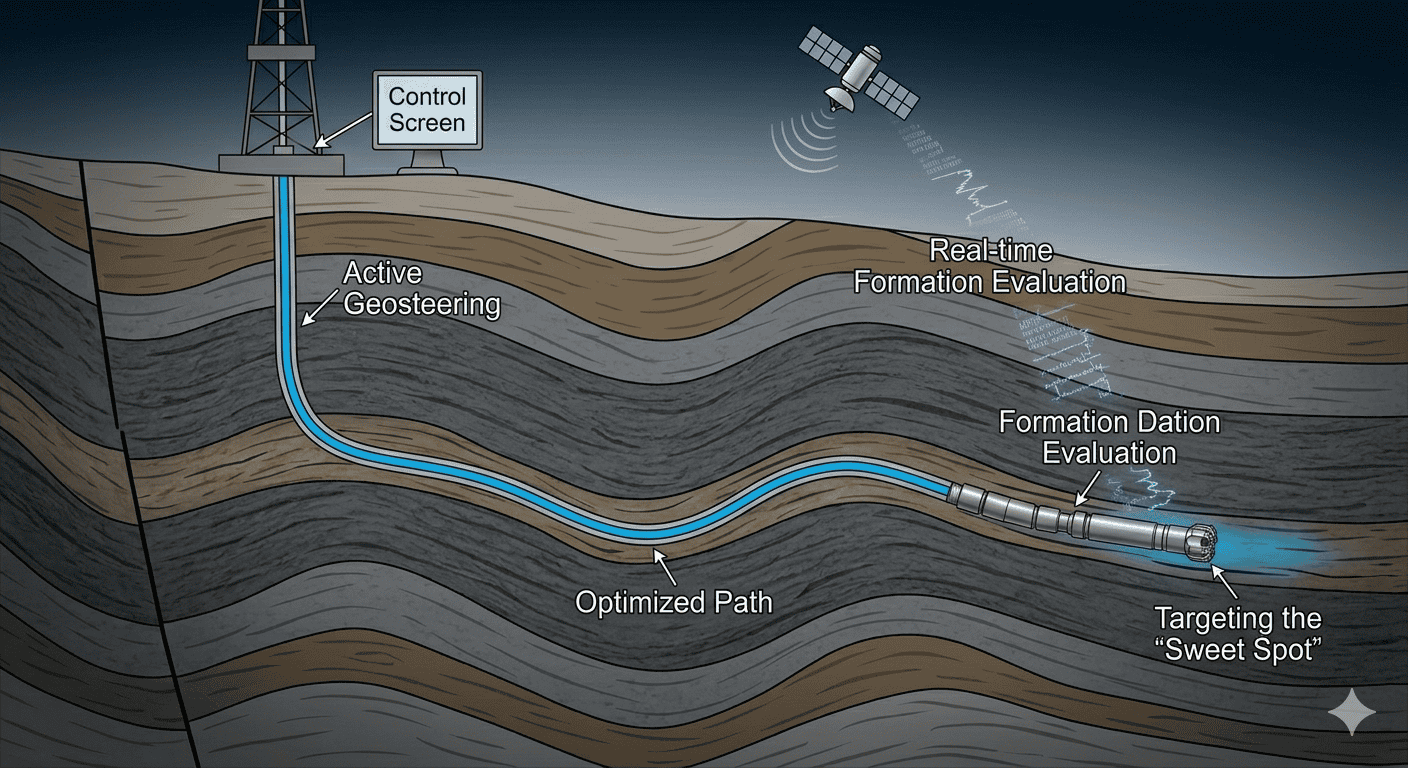
Where it gets truly impressive is the real-time monitoring. Measurement While Drilling (MWD) tools embedded in the BHA continuously measure the wellbore’s inclination, azimuth and toolface orientation, and transmit this data to surface in real time, encoded as pressure pulses in the mud column. The driller watches the well’s actual trajectory on a screen and adjusts the steering accordingly, keeping the wellbore within the planned corridor with a precision that can be measured in meters over a lateral of several kilometers.
In complex reservoirs, this real-time adjustment becomes geosteering: steering the well path using live geological and directional data so the lateral stays inside the best rock.
Real-time formation evaluation lets drillers adjust the well path while drilling and keep the lateral inside the target zone.
Think of it as threading a needle, from 4,000 meters above the needle, using a flexible thread that is kilometers long, guided by sensor data, geological knowledge and hard-won experience.
When Horizontal Drilling Is Not the Answer
A balanced article must acknowledge that horizontal drilling is not universally superior. It is the right answer to a specific set of geological and economic problems, not all of them.
In thick, high-permeability reservoirs such as the giant conventional fields of the Middle East, certain Jurassic sandstones of the North Sea, and deep carbonates in the Caspian, a vertical well may recover oil at high rates without the added cost or complexity of going horizontal. The cost premium of a horizontal well, which can be 2–3 times that of a comparable vertical well in the same location, may not be justified when a vertical well drains the reservoir effectively.
Similarly, in reservoirs where the primary flow paths are vertical rather than horizontal, fractured carbonates with predominantly vertical natural fractures, for instance, a horizontal well oriented in the wrong direction can perform worse than a vertical alternative.
The decision to drill horizontal is always an engineering and economic one. It requires understanding the reservoir geometry, the rock properties, the expected production rates, the well costs and the prevailing commodity price. It is never automatic. Field development planning is, at its core, the discipline of matching wellbore geometry to geological reality, and that match looks different in every basin on earth.
What This Means for the Industry’s Future
The implications of horizontal drilling extend well beyond production statistics.
The technology has unlocked resources that geologists identified decades ago but engineers could not reach economically. It has allowed development of thin-bedded reservoirs, tight formations and complex geological settings that once represented proven but unproducible hydrocarbons. It has enabled single offshore platforms to drain reservoir areas that previously would have required multiple facilities.
It has also raised the bar for what the industry considers technically achievable. Extended reach drilling now routinely places wellbore laterals 10, 12, even 15 kilometers from the surface location. Record-breaking wells have exceeded 15 kilometers of total measured depth, with lateral sections alone surpassing 10 kilometers, numbers that would have seemed absurd to the engineers who drilled the first intentional horizontal well in 1929.
The global energy transition will reshape many things about the upstream industry. What it will not change is the underlying geological reality: most reservoirs are thin, lateral, and far better suited to a wellbore that runs with them than one that cuts across them. As long as petroleum engineers are drilling wells into rock, the logic of horizontal drilling will remain as sound as it was when someone first looked at a thin formation and asked, what if we didn’t drill through it, but along it?