The drilling fluid system on a complex deepwater well can cost up to ten million dollars.
Not the rig. Not the casing strings. Not the wellhead equipment. The fluid, the carefully engineered liquid circulating continuously through the wellbore while the drill bit turns.
Most people have never heard of it. Most people outside the industry would assume the most important thing happening on a drilling rig is the bit cutting through rock. They would be wrong.
The bit cuts the rock. The drilling fluid, universally called mud, regardless of what it actually contains, does everything else. It is simultaneously a pressure vessel, a transport system, a cooling mechanism, a geological sensor and the primary barrier between a productive well and a catastrophic blowout. It is the most complex, most consequential and most chronically underappreciated engineering system on any wellsite.
This is its story.
What Mud Actually Does
The word mud is misleading. Early drilling fluids were, literally mud, water mixed with clay from the surface, used to carry cuttings out of the hole. Modern drilling fluids are precisely engineered chemical systems, mixed and maintained by specialist engineers, monitored continuously at surface, and adjusted in real time in response to what the wellbore is telling them.
A modern drilling fluid is simultaneously doing eight different jobs, all at once, none of which can be allowed to fail.
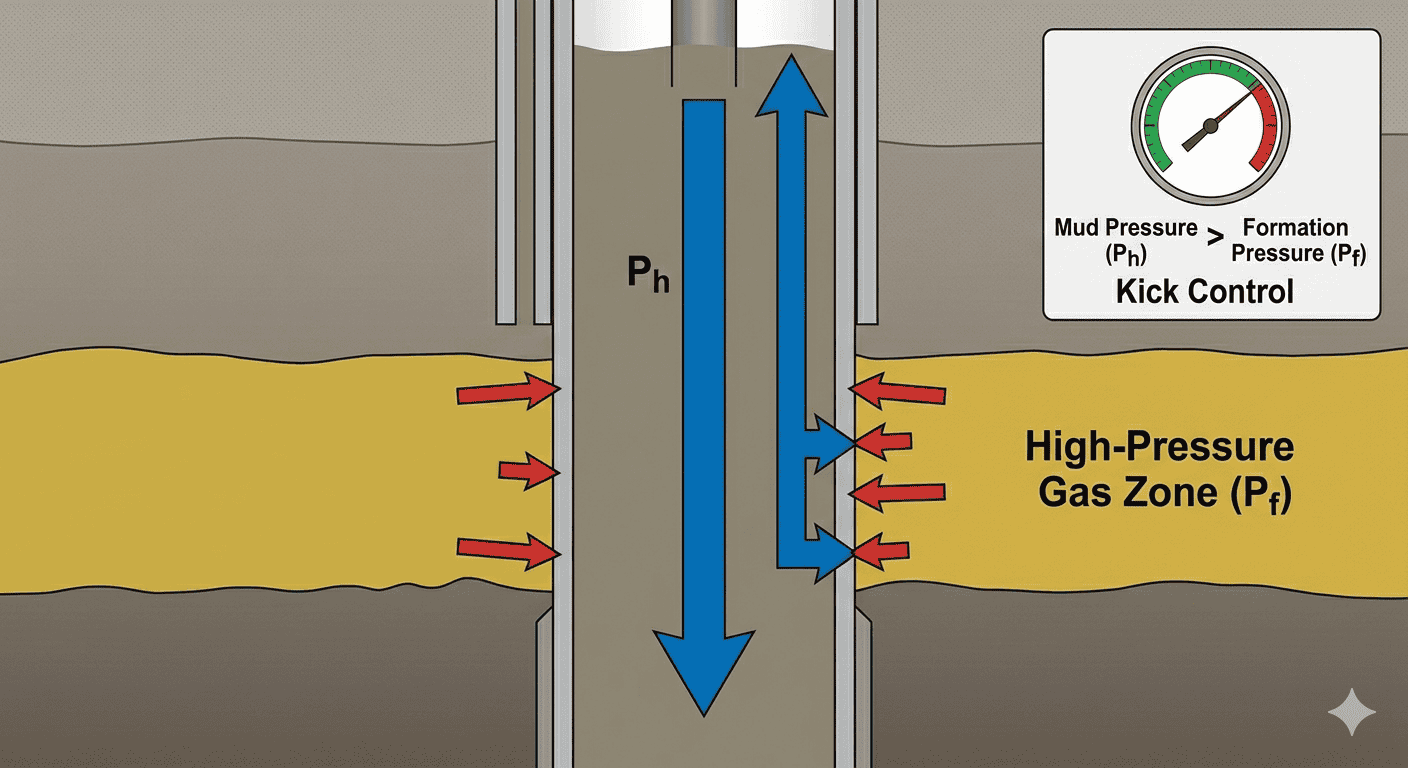
Controlling formation pressure. This is the function that matters most, and the one that most people outside the industry have never considered. Every formation drilled contains fluids such as water, gas, and oil, held at a specific pressure by the weight of the rock above it. If the pressure in the wellbore falls below the formation pressure, those fluids will flow into the wellbore. That is a kick. Uncontrolled, it becomes a blowout.
The primary mechanism for preventing this is hydrostatic pressure, the pressure exerted by the column of drilling fluid in the wellbore due to its own weight. A denser fluid exerts more pressure. A lighter fluid exerts less. The mud engineer’s fundamental challenge is keeping the hydrostatic pressure in the wellbore within the drilling window, above the formation pore pressure (to prevent influx) but below the formation fracture gradient (to prevent losing fluid into the formation). In complex wells, this window can be as narrow as a few tenths of a bar. Managing it requires constant attention, accurate data and precise fluid engineering.
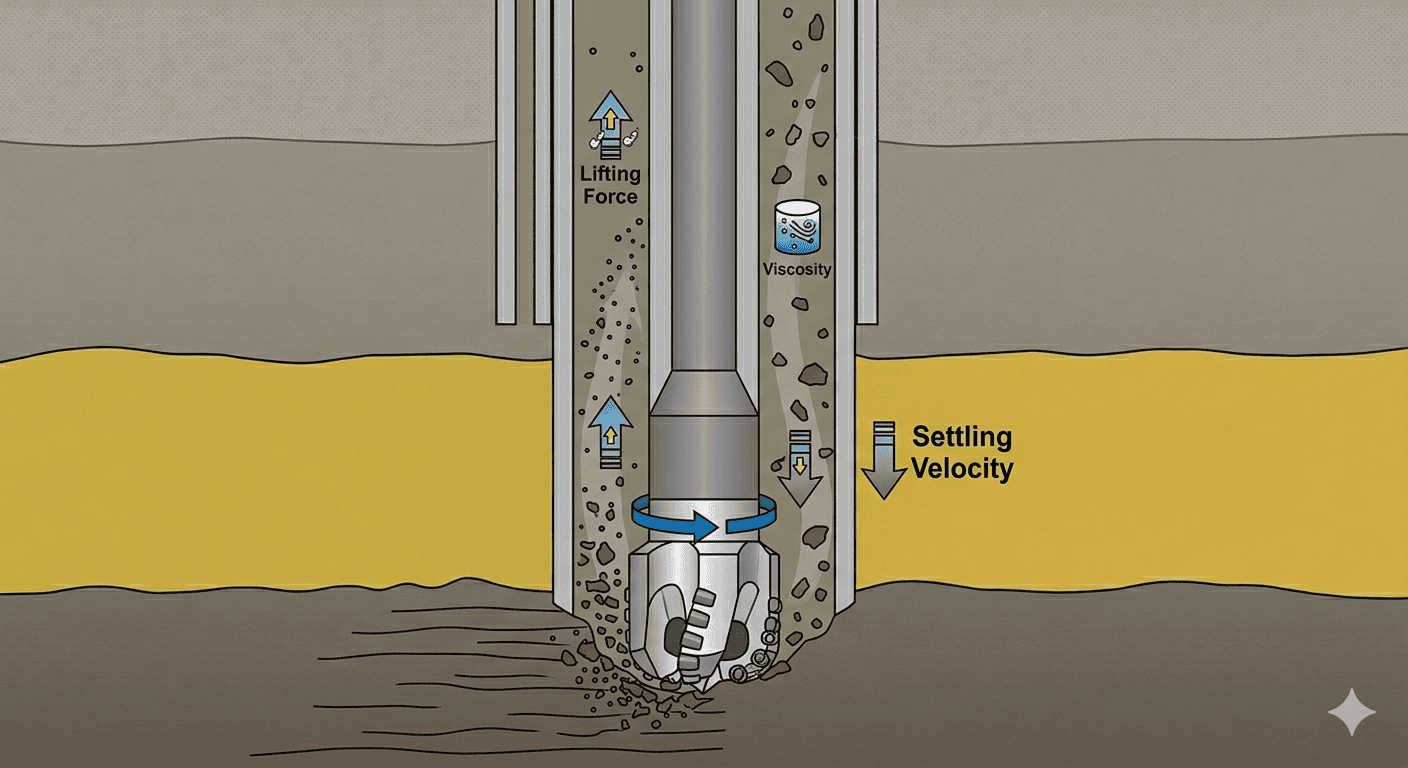
Transporting drill cuttings. Every meter of rock the bit destroys must be carried from the bit face to surface and disposed of. In a horizontal well with a 3,000-metre lateral section, those cuttings must travel thousands of meters through a pipe that is running nearly parallel to the ground, fighting gravity the entire way. If the fluid cannot carry cuttings efficiently, they accumulate on the low side of the wellbore, pack around the drill string, and cause exactly the kind of stuck pipe situation that costs the industry millions of dollars every year. Cutting transport is a function of fluid velocity, fluid density, fluid rheology and wellbore geometry, and getting it wrong is expensive.
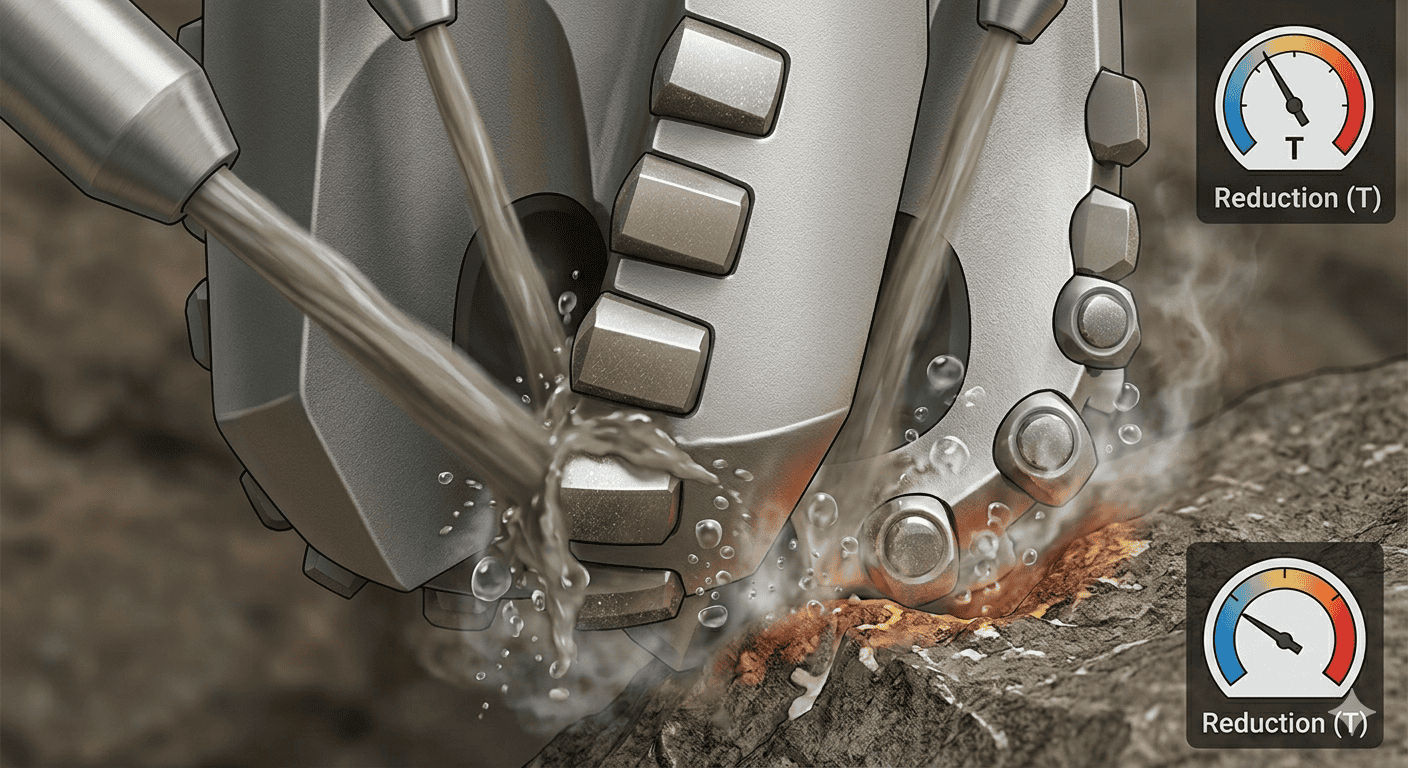
Cooling and lubricating the drill bit. At total depth, the bit is rotating at high speed against rock that may be exceptionally hard and abrasive. The heat generated is substantial. The drilling fluid, circulated continuously down through the drill string and back up the annulus, carries that heat away from the bit face and dissipates it at surface. Without effective cooling, bit life collapses. Without effective lubrication, particularly in deviated and horizontal wells where the drill string presses against the low side of the wellbore, torque and drag increase until the well becomes undrillable.
Stabilizing the wellbore walls. Many formations, particularly shales, are mechanically unstable. Left exposed to the wrong fluid, they swell, soften and collapse into the wellbore. The drilling fluid must be chemically compatible with the formation, inhibiting clay swelling, maintaining the mechanical integrity of the wellbore wall, and preventing the hole from becoming something other than the shape the driller intended. In reactive shale formations, the difference between a fluid that works and a fluid that doesn’t can mean the difference between a well that completes successfully and one that has to be abandoned.
Forming a filtercake. As the drilling fluid circulates against the wellbore wall, it deposits a thin, low-permeability layer called the filtercake, a membrane of solids from the fluid that seals the permeable formations and prevents excessive fluid loss into the rock. A good filtercake protects the reservoir from fluid invasion, maintains wellbore stability and prevents differential pressure sticking, a particularly unpleasant form of stuck pipe caused by the drill string being pressed against the wellbore wall by differential pressure. A poor filtercake causes all of the above to go wrong simultaneously.
Suspending cuttings when circulation stops. When the pumps are shut down for a drill pipe connection, or for any other reason, the cuttings in suspension must not immediately fall back to the bottom of the hole. The fluid must be engineered to behave like a liquid when flowing and like a weak solid when static, a property called thixotropy. Without it, every pump restart involves circulating through a bed of settled cuttings, increasing the risk of stuck pipe and wellbore damage.
Transmitting hydraulic power to downhole tools. The downhole motor that steers a directional well, the MWD tools that transmit real-time data to surface, the measurement sensors that tell the driller where the bit is, are all powered, partly or entirely, by the hydraulic energy of the circulating fluid. The fluid’s flow rate, pressure and density directly affect the performance of every tool in the bottomhole assembly. A fluid change that solves one problem can simultaneously compromise another system if the hydraulic implications are not carefully modelled.
Providing geological information. The cuttings carried to surface by the drilling fluid are the first physical samples of every formation drilled. The mud logger at surface examines them continuously, identifying lithology, detecting hydrocarbon shows, monitoring changes in drilling rate that signal formation changes. Changes in the returning fluid itself such as a sudden reduction in density indicating gas influx, a change in color indicating oil, can be the first warning sign of a well control event. The mud is not just a functional fluid. It is a geological sensor and a safety instrument simultaneously.
The Three Families of Drilling Fluid
Water-based mud (WBM) is the most widely used globally. The continuous phase is water, either fresh water, seawater or brine, with clays, polymers and chemical additives providing the required rheological and filtration properties. WBM is less expensive than the alternatives, easier to handle, and considerably simpler to dispose of, an important consideration in environmentally sensitive offshore and onshore locations. Its limitations are in highly reactive shale formations, where water-based systems can cause clay swelling and wellbore instability, and in high-angle wells, where lubrication becomes critical.
Oil-based mud (OBM) uses oil, traditionally diesel, now more commonly mineral oil or low-toxicity base oils, as the continuous phase, with water droplets emulsified within it. OBM provides excellent lubrication, superior shale inhibition and better performance in high-temperature, high-pressure environments. In formations where WBM would cause instability or wellbore collapse, OBM is often the only viable option. The trade-off is cost, handling complexity and environmental impact, OBM cuttings cannot be discharged to sea in most jurisdictions and require onshore treatment or disposal.
Synthetic-based mud (SBM) represents the attempt to get the performance of OBM with a more acceptable environmental profile. The base fluid is a synthetic compound, ester, olefin or ether-based, engineered to be more readily biodegradable than mineral oil. SBM is widely used in deepwater operations where performance requirements are high and environmental compliance is non-negotiable. It is also considerably more expensive than either WBM or OBM, making the economics sensitive to well complexity and environmental regulation.
The choice of fluid type is never made in isolation. It involves the well’s geological prognosis, the environmental regulations of the jurisdiction, the expected temperature and pressure conditions, the planned well trajectory, the availability of mixing and disposal infrastructure, and the project economics. A mud engineer who selects a fluid based on technical performance alone, without considering the full operational and commercial context, is not doing their job.
The Drilling Window — Where Everything Can Go Wrong
Understanding drilling fluids means understanding the concept of the drilling window, because everything the mud engineer does is in service of staying within it.
Every formation has two critical pressures. The first is the pore pressure, the pressure of the fluids contained within the rock’s pore spaces. The second is the fracture gradient, the pressure at which the formation rock will fracture and accept fluid rather than resist it.
The gap between these two pressures, expressed in terms of equivalent fluid density, is the drilling window. The mud weight must sit within this gap at all times.
If the mud weight falls below the pore pressure equivalent: formation fluids flow into the wellbore. This is a kick. If detected promptly and managed correctly, a kick can be circulated out of the well safely. If not, it becomes a blowout.
If the mud weight exceeds the fracture gradient equivalent: the formation fractures and drilling fluid is pumped into the rock. This is lost circulation, ranging from a minor inconvenience requiring lost circulation material to an uncontrolled situation that can destabilize the entire wellbore, cause the drill string to become stuck, or in extreme cases require the well to be abandoned.
In a simple, well-understood formation, the drilling window might be wide, a full mud weight range of half a kilogram per liter or more. In a deepwater well with narrow pore pressure and fracture gradient margins, the window might be a few hundredths of a kilogram per liter. In complex extended reach wells or HPHT environments, maintaining the fluid within that window across the entire wellbore length simultaneously is one of the most demanding engineering challenges in the industry.
This is why the mud engineer is never, ever an afterthought on a well.
The People Behind the Mud
The mud engineer or drilling fluids engineer is one of the most specialized and least glamorized roles on a wellsite. They are usually contracted from a drilling fluids service company rather than employed directly by the operator, living on the rig for weeks at a time, running tests on the active mud system multiple times per day, and adjusting the fluid properties in response to what the formation is doing.
Their primary tools are a set of standard tests carried out in a small laboratory on the rig: mud weight measurement, rheology (viscosity and gel strength), filtration testing, pH, chloride content, and various chemical analyses depending on the fluid type. These tests, run every few hours during active drilling operations, tell the mud engineer whether the fluid is performing as designed, and what needs to change if it is not.
What the mud engineer knows, that no test directly measures, is the relationship between the fluid properties on the surface and the conditions 4,000 meters below. Temperature and pressure change dramatically with depth. A fluid mixed to the right specifications at surface may behave very differently at bottomhole conditions. The mud engineer must think in three dimensions, the fluid at the bit, the fluid in the annulus at various depths, and the fluid in the surface tanks, simultaneously, and anticipate how changes in any one of them propagate through the system.
The best mud engineers have an almost intuitive sense of what the wellbore is doing from changes in the returning fluid. A slight increase in flow rate at the shakers. A change in the color of the returns. A subtle shift in the cuttings character. These are signals that something has changed downhole, and the mud engineer is often the first person to notice.
When The Mud Gets It Wrong
The consequences of a drilling fluid failure range from expensive to catastrophic, and it is worth understanding both ends of that range.
At the less severe end: poor rheology causes cuttings to settle on connections, building a cuttings bed in the lateral section. The drill string becomes progressively harder to rotate. Torque increases. Eventually the string cannot be moved, causing stuck pipe. The cost of freeing a stuck pipe, including lost rig time, jarring operations and potentially sidetracking, can run into millions of dollars per incident.
At the severe end: inadequate mud weight control causes a kick. A kick that is not detected promptly becomes an influx of formation fluid, potentially gas, entering the wellbore. Gas rises faster than liquid, expanding as it goes, displacing mud and reducing hydrostatic pressure further. If the situation is not caught and controlled using well control procedures, the hydrostatic pressure falls below pore pressure across the entire open hole section simultaneously. What follows is an uncontrolled blowout, the most dangerous, most expensive and most high-profile failure mode in the upstream industry.
Blowouts are rare. They are rare because the entire industry set well control procedures, blowout preventers, secondary barriers, and kick detection systems designed to prevent them. But at the foundation of all of that engineering lies the drilling fluid: the first line of defense, the primary pressure barrier, the system that is supposed to make every other layer of protection unnecessary.
This is why the mud that holds it all together deserves more than it usually gets.
A Final Note for the Petroleum Engineer Reading This
If you work in drilling, you know everything in this article. You may have found yourself nodding at some of it and wanting to add nuance to other parts. That is exactly the right reaction, and I would encourage you to share that nuance in the comments below. The Well Log is built on the idea that the people who know the most are the ones least often asked to explain it.
If you are early in your career, the single most valuable thing you can do on your next wellsite rotation is spend time with the mud engineer. Watch them run the tests. Ask them why the properties matter. Understand what they are looking for in the return flow. The wellbore tells you things through the mud that it cannot tell you any other way, and learning to read those signals is a skill that no textbook teaches.