In this article
01 · What happened
On 18 November 2026, Angola’s National Oil, Gas and Biofuels Agency (ANPG) and Sonangol Exploração & Produção announced an oil discovery in the Burututu-1 exploration well, in the offshore part of the Kwanza Basin. Sonangol E&P operates Block 5/06 with a 100% participating interest (OGJ).
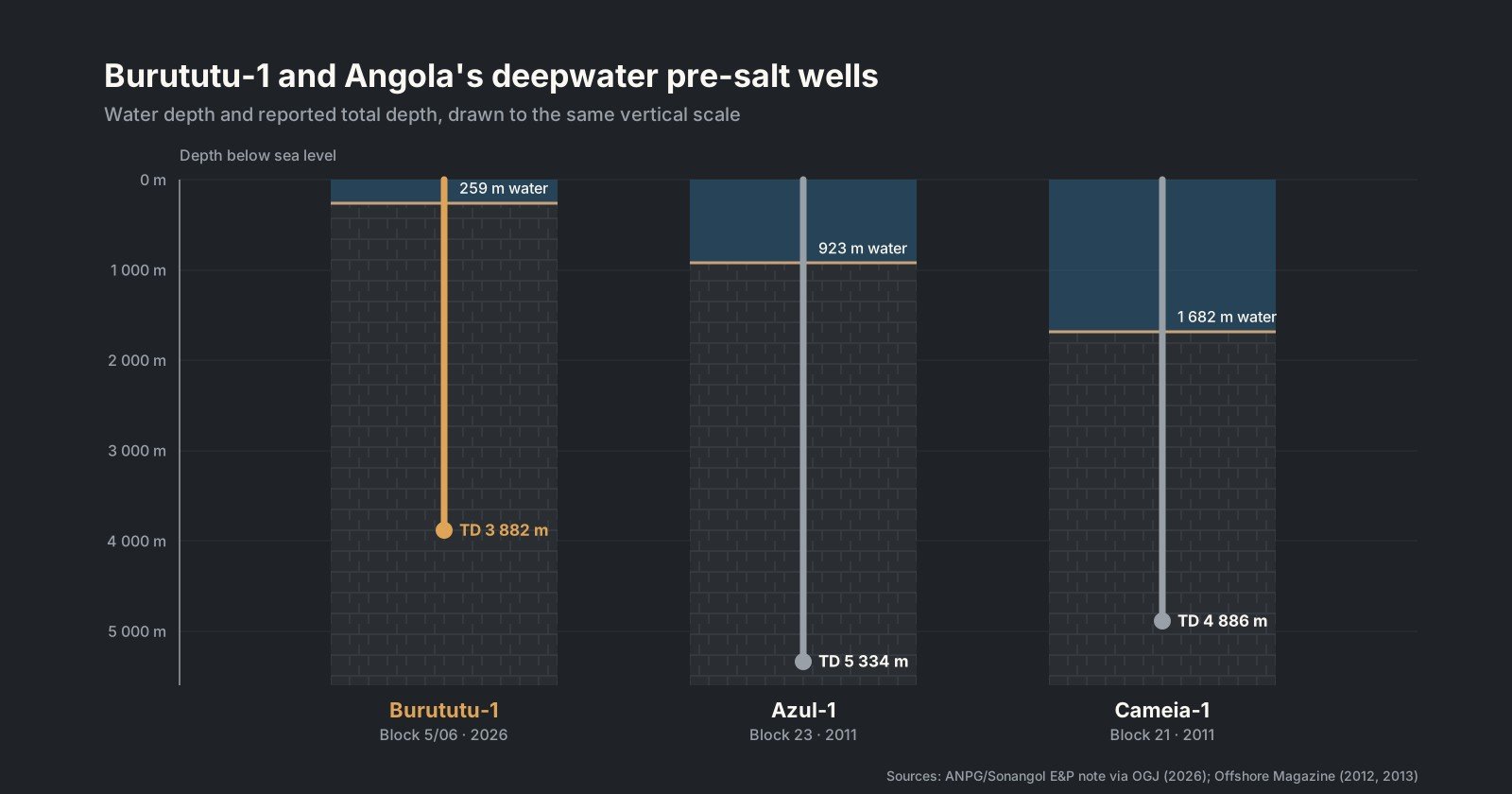
The well was drilled in 259 m of water to a total depth of 3,882 m and, on preliminary data, found 25 m of reservoir containing hydrocarbons. ANPG described it as the first identification of hydrocarbons in pre-salt reservoirs in this concession (Executive Digest; Forbes África Lusófona).
The well was drilled by the Seadrill-owned drillship West Gemini, contracted to Sonangol E&P through Sonadrill, the 50:50 joint venture between Seadrill and a Sonangol affiliate. Earlier in 2026 the same rig drilled the Katambi-2 appraisal well in Block 24, in the Benguela Basin (Drilling Contractor).
02 · What is behind it
The pre-salt refers to sedimentary sequences deposited before the widespread Aptian evaporites that later covered large parts of the offshore Kwanza Basin. Before the South Atlantic opened, the future Angolan and Brazilian margins formed part of the same rift system. That shared tectonic history is why the Kwanza Basin is often compared with Brazil’s Santos Basin (Offshore Magazine, 2013). It is an analogue, not a template: reservoir architecture, diagenesis, trap geometry and charge can differ considerably.
Pre-salt oil in Angola is not new. Dendém-1 (often written Denden-1), drilled in January 1983 in 213 m of water in what is now Block 9, penetrated 835 m of pre-salt section and tested about 786 bopd of 25° API oil, but was classed as a non-commercial discovery (ANPG, Block 9 portfolio). Mobil’s Baleia-1A followed in 1996 in Block 20 (EIA, 2015 brief). The modern deepwater campaign came with Maersk Oil’s Azul-1 in Block 23, the first well to penetrate pre-salt objectives in the Angolan deepwater, drilled in 923 m of water to 5,334 m (Offshore Magazine, 2012), and Cobalt’s Cameia-1 in Block 21, in about 1,682 m of water to 4,886 m (Offshore Magazine, 2013).
Burututu-1 sits back on the shelf: 259 m of water and a total depth of 3,882 m. In setting it is closer to Dendém-1 than to Cameia or Azul, a useful reminder that a shallow-water pre-salt result is promising, not proof of commerciality.
Block 5/06 is not virgin ground either. When its production sharing agreement was signed in November 2006, VAALCO held 40% and operated the concession, alongside InterOil at 40% and Sonangol at 20% (VAALCO release, SEC). The block covered about 1.4 million acres, 95% of it in less than 200 m of water (Gulf Oil & Gas, May 2006).
Historical disclosures agree that 12 wells had been drilled on the old Block 5 acreage in the 1980s and 1990s, but describe the results differently. VAALCO’s November 2006 release said at least five found hydrocarbons, none of them developed (SEC). A May 2006 report said three wells tested oil at 700 to 1,100 b/d and four more had oil shows, all deemed non-commercial at the time (Gulf Oil & Gas). These figures describe the old Block 5 acreage, whose limits may not match the current concession exactly. According to ANPG, Burututu-1 is the first well to find hydrocarbons in pre-salt reservoirs in the current concession (OGJ).
What the announcement does not say matters as much as what it does:
- Fluid characterisation. The joint announcement describes Burututu-1 as an oil discovery (Ver Angola), but the technical information released so far only states that the well encountered hydrocarbon-bearing reservoir. No PVT data, fluid properties, GOR or test results have yet been published.
- Net or gross. “25 m of reservoir with hydrocarbons” does not say whether this is net pay or a gross interval, nor what porosity, saturation or pressure were measured.
- Reservoir type and depth. No formation, lithology or depth of the reservoir top has been published, and the 3,882 m total depth is not stated as measured or vertical depth.
- Testing and volumes. No flow test, fluid samples or in-place estimate have been announced. The note says only that the geological and petrophysical characteristics justify further technical studies, and that the next phase will be decisive for assessing the potential (Executive Digest).
03 · My take
Twenty-five metres in 259 m of water is not a headline number, and it should not be sold as one. What makes Burututu-1 interesting to me is where it sits. Much of the international attention around Angola’s modern pre-salt campaign has focused on deepwater discoveries such as Cameia and Azul, where exploration wells and development infrastructure generally carry much higher capital requirements. A successful pre-salt accumulation in 259 m of water could offer a very different development cost structure, if reservoir quality, volumes, fluids and deliverability prove favourable.
Dendém-1 is the cautionary note: pre-salt oil, in shallow water, flowing on test, and still classed as non-commercial. Pre-salt reservoir quality can vary sharply over short distances, because lithology, facies and diagenesis strongly control porosity and permeability. A short interval of hydrocarbon-bearing rock in one well says little about lateral continuity, permeability or how much will flow.
The next evaluation phase will need to resolve what the discovery well alone cannot establish publicly: fluid properties and pressure, lateral reservoir quality and continuity, and ultimately deliverability. Some of that may come from data already acquired in the well; the rest could need a re-entry, a sidetrack or an appraisal well.
I also read Burututu-1 as a signal about Sonangol as an operator. Sonangol E&P drilled the well as the 100%-interest operator of the block, using a rig supplied through its joint venture, in an area where earlier discoveries were judged non-commercial. Whatever the volumes turn out to be, that is the kind of exploration a national company has to be willing to do if it wants to replace reserves rather than only manage decline.
04 · The Angolan angle
The joint note frames Burututu-1 as part of Sonangol’s push into exploration, aimed at replacing reserves and growing the oil production it operates itself (Executive Digest). That matters in a country whose total liquids production fell from about 1.8 million b/d in 2014 to about 1.2 million b/d in 2023, as mature fields declined and upstream investment slowed (EIA).
The Kwanza Basin is also moving from an exploration story toward a development, and eventually production, story. TotalEnergies describes Kaminho, in Block 20/11, as the first large deepwater development in the Kwanza Basin, with production start-up expected in 2028 (TotalEnergies). Burututu-1 adds a different piece to that picture: a pre-salt result on the shelf, operated by the national company.
The rig side is worth noting too. The well was drilled by the West Gemini through Sonadrill, Sonangol’s joint venture with Seadrill, which also drilled Katambi-2 for Sonangol earlier this year (Drilling Contractor). Repeated operated drilling campaigns can also create opportunities to deepen Angolan drilling and well-engineering capability.
05 · What to watch next
- The key question: what fluid is it, and will it flow? Look for ANPG or Sonangol to publish fluid properties, test results or an in-place estimate.
- Whether Sonangol announces an appraisal well, a re-entry or a sidetrack to test the extent and quality of the pre-salt reservoir.
- Whether this result, together with any appraisal data, changes how nearby shelf acreage is presented to investors.
Sources
- Oil & Gas Journal (18 November 2026). Sonangol discovers hydrocarbons offshore Kwanza basin. ogj.com
- Ver Angola (18 November 2026). Anunciada nova descoberta de petróleo no bloco 5/06 (reproduces the ANPG/Sonangol E&P note). verangola.net
- Executive Digest / Lusa (18 November 2026). Angola anuncia nova descoberta de petróleo na bacia do rio Kwanza. executivedigest.sapo.pt
- Drilling Contractor (18 November 2026). West Gemini drills Sonangol pre-salt discovery in Kwanza Basin. drillingcontractor.org
- Forbes África Lusófona (19 November 2026). Sonangol identifica 25 metros de reservatório com hidrocarbonetos no Bloco 5/06. forbesafricalusofona.com
- TotalEnergies (21 May 2024). Angola: TotalEnergies launches the Kaminho deepwater project. totalenergies.com
- U.S. EIA (26 February 2025). Country Analysis Brief: Angola. eia.gov
- U.S. EIA (19 March 2015). Country Analysis Brief: Angola (Baleia-1A, Denden 1). connaissancedesenergies.org
- ANPG. Portfólio de Oportunidades, Bloco 9 (Dendém-1). anpg.co.ao
- Offshore Magazine (4 January 2012). Azul well confirms Angola presalt potential. offshore-mag.com
- Offshore Magazine (15 January 2013). Operators size up Africa’s presalt deeps. offshore-mag.com
- VAALCO Energy (7 November 2006). Press release on the Block 5/06 PSA, filed with the SEC. sec.gov
- Gulf Oil & Gas (17 May 2006). VAALCO Awarded Stake in Block 5 Offshore Angola. gulfoilandgas.com
The views expressed on The Well Log are my own and do not represent those of my current or former employers. All information is drawn from public sources.