Every time a casing string is cemented and the shoe is drilled out, the well enters new rock with a new limit. Before drilling ahead, the crew needs to establish how much pressure the casing-shoe and formation system can safely withstand and, where a LOT is performed, the pressure at which fluid first begins to leak off into the exposed formation. Both answers come from a formation strength test, usually a leak-off test (LOT) or a formation integrity test (FIT).
The ECD article showed the drilling window: mud weight and ECD have to stay between pore pressure and fracture pressure, and the previous casing shoe is commonly used as the reference weak point, although the weakest exposed formation may lie elsewhere in the open hole. The kicks article showed what happens when the bottom of that window is crossed. This article is about the top of the window: how it is tested, and how the result feeds one of the key surface pressure limits on the rig, the MAASP.
It also matters for reading accidents. At Macondo, the team lost returns at the bottom of the well and had “run out of drilling margin” (Case Files 01). A margin is only as reliable as the test that measured its upper edge.
In this article
LOT, FIT and XLOT: three tests, three questions
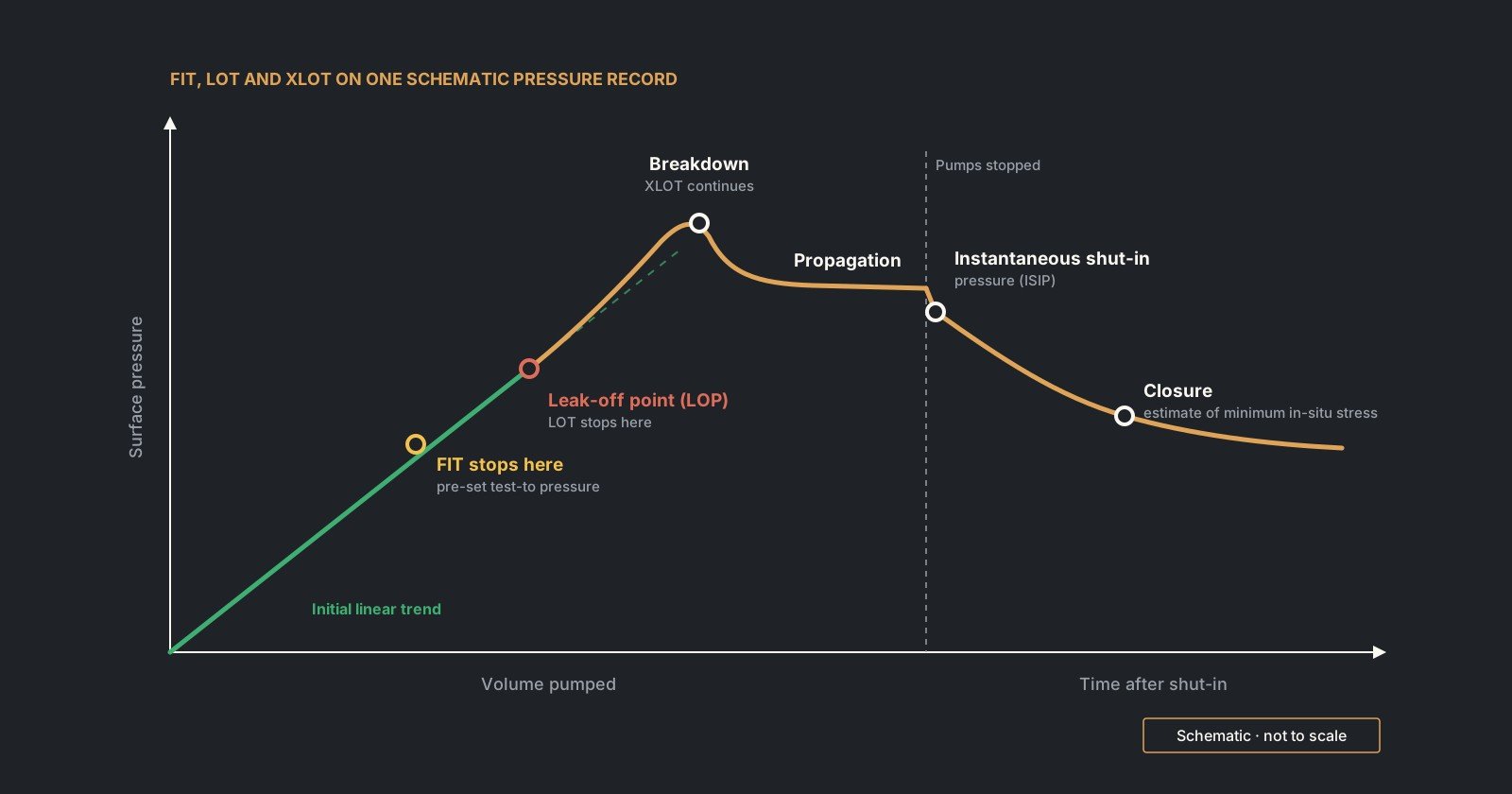
The three tests use the same equipment and the same set-up. What changes is when the pumping stops, and so what question the test answers.
| Test | Pumping stops when | Question it answers | What you learn |
|---|---|---|---|
| Formation integrity test (FIT) | A pre-set “test-to” pressure is reached | Can the shoe hold the pressure we plan to apply? | A proven lower bound on formation strength; not the actual strength |
| Leak-off test (LOT) | The pressure-volume plot shows a sustained departure from its initial linear trend | At what applied pressure does the wellbore and formation system begin to show sustained leak-off? | The leak-off pressure, or equivalent leak-off mud weight, used operationally to set an upper pressure limit with an appropriate safety margin |
| Extended leak-off test (XLOT) | Beyond initial leak-off: a small fracture is deliberately initiated and propagated, then the well is shut in and the pressure decline analysed | What is the minimum in-situ stress? | Fracture closure and reopening behaviour, used to estimate the minimum in-situ stress (the minimum horizontal stress where that stress is horizontal) |
PetroWiki compares a FIT to testing a pressure vessel to its rated operating pressure, and a LOT to testing it until it leaks or deforms (PetroWiki). The trade-off follows from that. A properly executed FIT is intended to stop before leak-off and so avoid deliberately fracturing the formation, but it only proves the system can take the test pressure. A LOT provides an observed leak-off limit under the test conditions, which can then be used operationally with an appropriate margin. Because a LOT may initiate or extend a fracture, it can alter the near-wellbore pressure response and affect later integrity tests. The same page notes that a planned FIT becomes a LOT if leak-off happens before the test-to pressure, and that the two terms are often confused in reports.
Leak-off and fracture are not the same thing. The SLB Energy Glossary notes that fluid can enter the formation through permeable paths in the rock or by fracturing it, so the leak-off point marks where the system starts to take fluid, not necessarily where the rock breaks down. For stress estimation, Enever et al. (1996) found in Australian field data that extended tests gave lower minimum-stress estimates than standard leak-off tests, one reason a standard LOT is not a substitute for an XLOT when stress is the question. All three tests also depend on the integrity of the casing, cement, shoe and formation system. An unexpectedly low or abnormal response can therefore point to a cement or shoe-integrity problem rather than weak formation alone (PetroWiki; Allerstorfer, 2011, pp. 38–41).
Running the test
Company procedures differ. The sequence below illustrates a common LOT and FIT workflow, following the procedure described by Allerstorfer (2011, pp. 17–19) in a study of leak-off tests run by OMV.
- Drill out the shoe and a few metres of new formation. In the referenced procedure, 3 to 5 m (10 to 16 ft) below the shoe, so the test sees fresh rock and not only cement, with the bit then pulled back inside the casing. Other procedures may differ.
- Condition the mud. Circulate, usually at least one bottoms-up, so the mud has a uniform density with no gas or excess solids. The calculation assumes a known, even mud weight.
- Close the BOP. The well is closed at surface, so pressure can be applied to the casing, shoe and short open-hole section.
- Pump slowly at a constant rate. In the referenced procedure, about 0.25 to 0.5 bbl/min, and up to 1 bbl/min in permeable rock. Record pressure against cumulative volume pumped.
- Watch the plot, not just the gauge. Initially, pressure normally follows an approximately linear pressure-volume response, which mainly reflects compression of the fluid and elastic expansion of the wellbore and surface system. The leak-off point is the first sustained, permanent departure from that initial linear trend: the system has started to take fluid (SLB Energy Glossary).
- Stop pumping and shut in. For a LOT, stop as soon as the deviation is clear. For a FIT, stop at the test-to pressure. Monitor the shut-in pressure for 10 to 15 minutes.
- Bleed back and record the returned volume. If most of the pumped volume comes back, the response was mainly compression; a large shortfall means fluid went into the formation.
The pressure versus volume plot is the tool for picking the leak-off point; pressure versus time is used for the shut-in phase (Allerstorfer, 2011, pp. 4, 17). A reference line fitted to the initial linear part of the measured response makes the departure easier to identify; some procedures also compare it with the predicted system compressibility.
The calculation: from surface pressure to equivalent mud weight
At the leak-off point, the pressure at the shoe is the mud hydrostatic plus the surface pressure the pump has added. Dividing by 0.052 × TVD turns that into an equivalent mud weight (EMW), the density of a mud that would put the same pressure on the shoe with no surface pressure at all. The IADC well control formula sheet gives it as:
EMWLOT (ppg) = MWtest (ppg) + PLOT (psi) / [0.052 × TVDshoe (ft)]where MW_test is the mud weight in the hole during the test and P_LOT is the surface pressure at the leak-off point (IADC WellSharp formula sheet, formula 24, where the result is called the maximum allowable mud weight).
Worked example
A 13⅜ in. casing shoe sits at 6,000 ft TVD. The test is run with 10.0 ppg mud, and the plot shows a sustained departure from its initial linear trend at 1,250 psi surface pressure.
EMW = 10.0 + 1,250 / (0.052 × 6,000)
    = 10.0 + 4.006
    = 14.006 ppg  →  14.0 ppg
The IADC sheet says to round leak-off EMW down to one decimal place, never up. Rounding up would credit the formation with strength it was not shown to have.
Expressed as a pressure, the equivalent pressure at the shoe at the observed leak-off point was about 0.052 × 14.0 × 6,000 = 4,368 psi.
The FIT version
A FIT runs the calculation in reverse. If the plan for the next section needs the shoe to hold at least 13.0 ppg EMW, and the hole holds 10.0 ppg mud, the test-to pressure is:
P_test = (13.0 − 10.0) × 0.052 × 6,000 = 936 psiIf the shoe holds 936 psi without leak-off, the test proves 13.0 ppg EMW. It says nothing about whether the real limit is 13.1 or 15.0 ppg.
Using the result: an operational limit and MAASP
The leak-off EMW becomes two working limits for the section below the shoe.
1. An operational upper pressure limit at the reference weak point. The LOT or FIT result helps set the operational upper-pressure boundary at the shoe, after applying the margin required by the well plan. The SLB Energy Glossary notes that the maximum operating pressure is usually set slightly below the leak-off test result. While circulating, the ECD at the shoe has to stay below that limit.
2. MAASP, the maximum allowable annular surface pressure. MAASP is the maximum annular surface pressure permitted during a well-control condition. If the well is shut in on a kick, the casing pressure adds to the mud hydrostatic at the shoe. The formation-strength calculation below gives the casing pressure at which the shoe would reach its leak-off pressure. Casing burst, wellhead and BOP ratings and other design constraints may impose a lower value, and the lowest applicable limit governs:
MAASP (psi) = (EMWLOT − MWcurrent) × 0.052 × TVDshoe (ft)(IADC WellSharp formula sheet, formula 25.)
Worked example, continued
With the 14.0 ppg leak-off EMW from above and the shoe at 6,000 ft TVD:
| Current mud weight | MAASP |
|---|---|
| 10.5 ppg | (14.0 − 10.5) × 0.052 × 6,000 = 1,092 psi |
| 12.0 ppg | (14.0 − 12.0) × 0.052 × 6,000 = 624 psi |
All else equal, the heavier the mud, the smaller the MAASP, because more of the shoe’s strength is already used up by hydrostatic pressure. That is why MAASP must be recalculated every time the mud weight changes, and why the current value should always be visible to the driller.
Two limits of the simple formula are worth knowing. It assumes the annulus above the shoe is full of mud of the current weight; once gas from a kick is in the casing annulus, that assumption is gone. And it assumes the shoe is the controlling weak point. If another exposed interval has a lower allowable pressure than the casing-shoe reference, that interval becomes the controlling weak point, which PetroWiki notes is a common blind spot.
Common pitfalls
- Using measured depth instead of TVD. Pressure depends on vertical height. In the example, using a measured depth of 6,400 ft instead of 6,000 ft TVD gives 13.7 ppg instead of 14.0 ppg. In a deviated well the error grows with inclination.
- Mud that is not what the calculation assumes. Gas-cut or poorly conditioned mud changes both the hydrostatic and the compressibility of the system. This is why the mud is circulated to a uniform weight first (Allerstorfer, 2011, p. 17).
- Gel strength. The first pressure the pump sees includes breaking the mud’s gels, which has nothing to do with the rock (pp. 43–44).
- Compressibility mistaken for leak-off. In the cased hole, most of the pumped volume simply compresses the mud. A plot that bends early can reflect trapped air or gas, not the formation (pp. 27–31).
- Permeable rock. Filtration into a permeable formation can make the curve non-linear before any fracture opens, so the leak-off point is harder to pick (pp. 35–36).
- A bad cement job at the shoe. A channel behind the casing can give a low or distorted result that looks like weak rock (pp. 38–41). A low LOT is a question about the cement as well as the formation.
- Surface gauge effects. Surface pressure readings are affected by mud compressibility and casing expansion; downhole pressure measurements, where available, can reduce some of the uncertainty of inferring shoe pressure from surface readings (pp. 44–46).
- Treating a FIT as a LOT. A FIT result is a proven minimum, not the leak-off pressure. Using it as the real limit hides how much margin there is, in either direction.
Key takeaways
- A FIT proves the shoe can hold a chosen pressure; a LOT observes where the system starts to take fluid under the test conditions; an XLOT goes further to estimate the minimum in-situ stress from fracture closure and reopening behaviour.
- Leak-off is the first sustained, permanent departure from the initial linear trend on a pressure versus volume plot. It is not the highest pressure reached, and not necessarily the fracture breakdown pressure.
- EMW = test mud weight + leak-off surface pressure / (0.052 × shoe TVD). Round down.
- MAASP = (leak-off EMW − current mud weight) × 0.052 × shoe TVD. All else equal, it shrinks every time the mud gets heavier, and casing or equipment ratings may set a lower limit.
- Always use TVD, conditioned mud and a plot drawn during the test.
- A low result can be weak rock or poor cement. Both matter before drilling ahead.
Next in Drilling Fundamentals: kick tolerance, which combines the leak-off result with the size of influx a well can safely take.
Sources
- SPE PetroWiki, Formation integrity test.
- SLB Energy Glossary, leakoff test and leak-off.
- C. Allerstorfer, Investigation of the “Plastic-Behavior” Region in Leak-Off Tests, MSc thesis, Montanuniversität Leoben (2011).
- IADC, WellSharp Formula Sheet, Field Units, Revision 4 (March 2025), formulas 17, 24 and 25 and rounding rules.
- J.R. Enever, N. Yassir, D.R. Willoughby and M.A. Addis, Recent experience with extended leak-off tests for in-situ stress measurements in Australia, The APPEA Journal 36(1), 528–535 (1996).
Worked-example numbers are illustrative and were checked by calculation. They do not come from a real well.