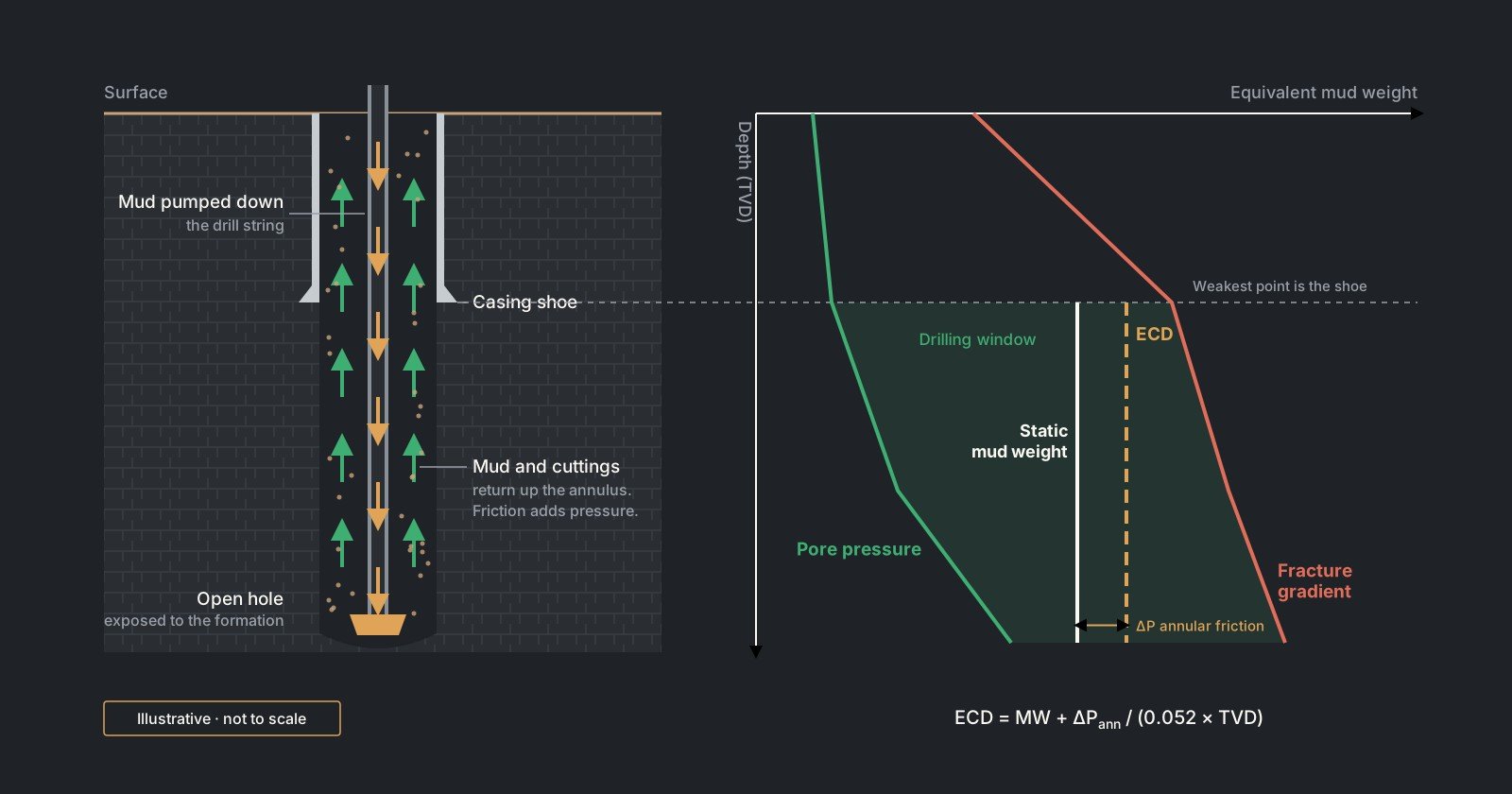
Every mud weight decision on a drilling rig comes back to two numbers. The first is the hydrostatic pressure the mud column exerts when it is standing still. The second is the equivalent circulating density (ECD): the effective density the formation feels when the pumps are running. Get the first too low and the well can flow. Get the second too high and the rock can fracture and the mud is lost.
This article explains both, step by step, with worked examples in oilfield units. It is the foundation for topics such as casing design, kick tolerance and well control, which this series covers later. For how these numbers shape a real well architecture, see Anatomy of a Deepwater Well Offshore Angola.
In this article
1. Hydrostatic pressure
In drilling, hydrostatic pressure is the force per unit area caused by a column of fluid. In oilfield units it is calculated as (SLB Energy Glossary):
Phyd (psi) = 0.052 × MW (ppg) × TVD (ft)where MW is the mud weight in pounds per gallon and TVD is the true vertical depth in feet.
Where does 0.052 come from? A cubic foot holds about 7.48 US gallons, and a square foot is 144 square inches. A column of 1 ppg fluid, 1 ft tall and 1 ft² in area, weighs 7.48 lb and spreads that weight over 144 in²:
7.48 lb / 144 in² ≈ 0.052 psi per ft, per ppgSo 0.052 is the field-unit conversion factor that gives the pressure gradient, in psi/ft, for a fluid density expressed in ppg: a 1 ppg fluid has a hydrostatic gradient of about 0.052 psi/ft. Multiply it by the mud weight and you get the gradient of your mud; multiply by depth and you get the pressure.
Why TVD and not measured depth? Hydrostatic pressure depends only on the vertical height of the fluid column, not on the length of the hole. A deviated well with 13,000 ft of measured depth (MD) and 10,000 ft of TVD has the hydrostatic pressure of a 10,000 ft column. This is one of the most common mistakes in student calculations.
In metric units, with density expressed as specific gravity (SG) and depth in metres, the same physics gives:
Phyd (bar) = 0.0981 × SG × TVD (m)Worked example 1: hydrostatic pressure
A well is drilled with 10.5 ppg mud. What is the hydrostatic pressure at 10,000 ft TVD?
- Mud gradient: 0.052 × 10.5 = 0.546 psi/ft.
- Pressure: 0.546 × 10,000 = 5,460 psi.
The same well in metric: 10.5 ppg is about 1.26 SG, and 10,000 ft is 3,048 m, so 0.0981 × 1.26 × 3,048 ≈ 377 bar, which matches 5,460 psi within rounding.
2. Equivalent mud weight and the drilling window
Engineers like to compare everything in the same unit as the mud. Rearranging the hydrostatic equation turns any pressure at a given depth into an equivalent mud weight (EMW): the mud weight that would produce that pressure at that depth.
EMW (ppg) = P (psi) / [0.052 × TVD (ft)]Pore-pressure and fracture-gradient limits are often converted to equivalent mud-weight units on well plans, which allows direct comparison with mud weight and ECD. Once both limits are in ppg, the drilling window becomes easy to read: the mud weight, and later the ECD, must stay between them.
Worked example 2: reading the window
At 10,000 ft TVD, the pore pressure is 5,200 psi and the fracture pressure is 5,820 psi. The well is drilled with 10.5 ppg mud.
- Pore pressure as EMW: 5,200 / (0.052 × 10,000) = 5,200 / 520 = 10.0 ppg.
- Fracture pressure as EMW: 5,820 / 520 = 11.19 ppg.
- Static overbalance: the mud exerts 5,460 psi (example 1), so the overbalance is 5,460 − 5,200 = 260 psi, or 0.5 ppg.
With the pumps off, the well sits comfortably inside a window of 10.0 to 11.19 ppg. The next section shows what happens when the pumps come on.
3. Equivalent circulating density (ECD)
When the pumps are running, the mud returning up the annulus has to overcome friction. That friction adds pressure at every point below it, so the bottom of the hole feels more than the static hydrostatic pressure. ECD expresses that total as a density: the effective density exerted by a circulating fluid against the formation, taking into account the pressure drop in the annulus above the point being considered (SLB Energy Glossary).
ECD (ppg) = MW (ppg) + ΔPann (psi) / [0.052 × TVD (ft)]Here ΔPann is the annular friction pressure loss between the point of interest and the surface, and TVD is the true vertical depth of that same point. This equation is the standard field representation; detailed hydraulics models also account for downhole fluid-property changes, well geometry, rheology and solids loading. The same glossary describes ECD as an important parameter in avoiding kicks and losses, particularly in wells with a narrow window between the fracture gradient and the pore-pressure gradient (SLB).
Worked example 3: ECD in a vertical well
Using the same well (10.5 ppg mud, 10,000 ft TVD, fracture pressure 5,820 psi), the hydraulics model gives an annular friction loss of 250 psi at the planned flow rate.
- ECD = 10.5 + 250 / 520 = 10.5 + 0.48 = 10.98 ppg.
- Circulating bottomhole pressure = 5,460 + 250 = 5,710 psi.
- Margin to fracture: 5,820 − 5,710 = 110 psi, or about 0.21 ppg.
Now suppose the driller increases the flow rate to clean the hole better, and the annular friction rises to 400 psi:
- ECD = 10.5 + 400 / 520 = 11.27 ppg, above the 11.19 ppg fracture EMW.
- Circulating bottomhole pressure = 5,460 + 400 = 5,860 psi, which exceeds the 5,820 psi fracture pressure.
The mud weight did not change at all, yet the well has moved outside its window. While circulating, ECD, not static mud weight alone, must remain within the allowable pressure window.
Worked example 4: the same depth in a deviated well
Consider a deviated well reaching the same 10,000 ft TVD at 13,000 ft MD. The hydrostatic pressure is still 5,460 psi, because it depends only on TVD. Annular friction, however, builds up along the whole length of the annulus. For illustration only, and not as a hydraulics model, assume the longer annulus increases friction in direct proportion to measured length, so 250 psi becomes about 325 psi. In reality, annular pressure loss also depends on geometry, pipe eccentricity, rheology, flow regime, cuttings, inclination and rotation.
- ECD = 10.5 + 325 / 520 = 11.13 ppg.
- Margin to fracture: 5,820 − (5,460 + 325) = 35 psi, or about 0.07 ppg.
The ECD denominator is TVD, while annular friction accumulates along the circulating flow path. This is one reason long, high-angle and extended-reach wells can become strongly ECD-constrained.
When the pumps stop
With the pumps off, the circulating annular-friction contribution disappears as the well returns to static conditions, and the bottomhole pressure falls back to the static hydrostatic value: 5,460 psi in our example, still 260 psi above pore pressure. The well must be safe in both states. Pipe movement matters too: pulling pipe out of the hole can swab, reducing bottomhole pressure below the static value, while running pipe in can surge, increasing it. Tripping speeds are chosen with both effects in mind.
What drives ECD
- Flow rate. More flow means more annular friction.
- Mud rheology. The fluid’s viscosity and yield behaviour influence annular pressure losses; more resistant rheology generally increases circulating pressure loss under otherwise similar conditions.
- Annular clearance. A tight annulus between pipe and hole, or pipe and casing, raises friction. This is one reason hole enlargement can help in narrow-window sections.
- Cuttings load. Suspended cuttings increase the effective density of the annular mixture, while cuttings beds in inclined sections can reduce the effective annular flow area and increase friction (Li et al., 2023). High rate of penetration combined with inadequate hole cleaning can therefore raise ECD.
- Temperature and pressure. Mud density and rheology change downhole. Real-time hydraulics systems use calculated temperature profiles to continuously adjust drilling-fluid properties, and in one published comparison the calculated ECD was typically within 0.1 lb/gal of annular-pressure-while-drilling measurements under normal drilling conditions (Roy and Power, AADE-02-DFWM-HO-37).
In practice, ECD is predicted with hydraulics software before drilling and checked during drilling against pressure-while-drilling measurements, where annular-pressure or PWD measurements are available.
Quick reference
| Quantity | Formula (oilfield units) | Units |
|---|---|---|
| Mud gradient | 0.052 × MW | psi/ft |
| Hydrostatic pressure | 0.052 × MW × TVD | psi |
| Equivalent mud weight | P / (0.052 × TVD) | ppg |
| ECD | MW + ΔPann / (0.052 × TVD) | ppg |
| Hydrostatic pressure (metric) | 0.0981 × SG × TVD | bar (TVD in m) |
Try it yourself
A well is drilled with 9.8 ppg mud. At 8,500 ft TVD, the pore pressure is 9.2 ppg EMW and the fracture gradient is 10.4 ppg EMW. The hydraulics model predicts 180 psi of annular friction at that depth.
- What is the hydrostatic pressure at 8,500 ft?
- What is the static overbalance over pore pressure, in psi?
- What is the ECD?
- What is the margin between the ECD and the fracture gradient, in ppg and psi?
- How much annular friction could the well tolerate before the ECD reaches the fracture gradient?
Answers
- 0.052 × 9.8 × 8,500 = 4,332 psi.
- (9.8 − 9.2) × 0.052 × 8,500 = 0.6 × 442 = 265 psi.
- 9.8 + 180 / 442 = 9.8 + 0.41 = 10.21 ppg.
- 10.4 − 10.21 = 0.19 ppg, or about 0.19 × 442 ≈ 85 psi.
- (10.4 − 9.8) × 442 = 265 psi of annular friction, before any safety margin.
Next in this series: what happens when the pressure balance is lost. Read Kicks, SIDPP and Kill Mud Weight: Reading a Shut-In Well.
Key takeaways
- For the standard uniform-density hydrostatic calculation, pressure depends on mud weight and TVD, not measured depth.
- A 1 ppg fluid corresponds to a hydrostatic gradient of about 0.052 psi/ft.
- Converting pressures to equivalent mud weight lets you compare pore pressure, fracture pressure, mud weight and ECD on one scale.
- ECD adds annular friction to the static mud weight, so the well can leave its window when the pumps come on, even with no change in mud weight.
- Longer and more complex annular flow paths generally increase frictional pressure losses, while ECD remains referenced to TVD, which makes ECD a frequent limit in deviated and extended-reach wells.
The views in this article are my own and are based on public sources and general industry practice. The worked examples use illustrative numbers and do not describe any specific well.
Sources
- SLB Energy Glossary. Hydrostatic pressure. glossary.slb.com
- SLB Energy Glossary. Equivalent circulating density. glossary.slb.com
- Roy, S. and Power, D. (2002). Using Real-Time Hydraulics Modeling to Complement Annular-Pressure-While-Drilling Data. AADE-02-DFWM-HO-37, AADE Technical Conference. aade.org
- Li, B., Wang, X., Zhang, F., Wang, X., Wang, Y. and Wang, Y. (2023). A mechanistic model for minimizing pressure loss in the wellbore during drilling by considering the effects of cuttings. Frontiers in Earth Science 10: 1036281. DOI: 10.3389/feart.2022.1036281