01 · What happened
In September 2026, at the Angola Oil & Gas conference in Luanda, TotalEnergies announced Acacia-5, an oil discovery made in June 2026 on Block 17, where it is operator with 38%. The company said it expected first oil within three months of the June discovery, through a fast-track development using available capacity on the Pazflor FPSO, and that Acacia-5 would add about 6,000 barrels per day to Block 17 production (TotalEnergies; OGJ; World Oil).
That was a target, not yet a confirmed result. At the time of writing, I could not find a public announcement confirming that Acacia-5 has actually reached first oil. That does not mean the schedule slipped; it means the public record so far supports only the announced target.
In the same announcement, TotalEnergies took 40% operated stakes in two new exploration blocks, 17/25 and 32/21, alongside ExxonMobil (40%) and Sonangol E&P (20%). The company said their proximity to Blocks 17 and 32, where six FPSOs are producing, allows future tiebacks and cost-efficient development through existing facilities (TotalEnergies).
02 · What is behind it
A three-month discovery-to-first-oil target clearly depends on infrastructure that already exists; it is not a conventional greenfield development timeline. Pazflor came on stream in August 2011 and produces four fields: three Miocene reservoirs with heavy, viscous oil (Perpetua, Hortensia and Zinia) and Acacia, an Oligocene reservoir (TotalEnergies). TotalEnergies describes Acacia-5 as a nearby discovery, and it lies close enough to existing Pazflor infrastructure for the company to plan a fast-track development through the FPSO.
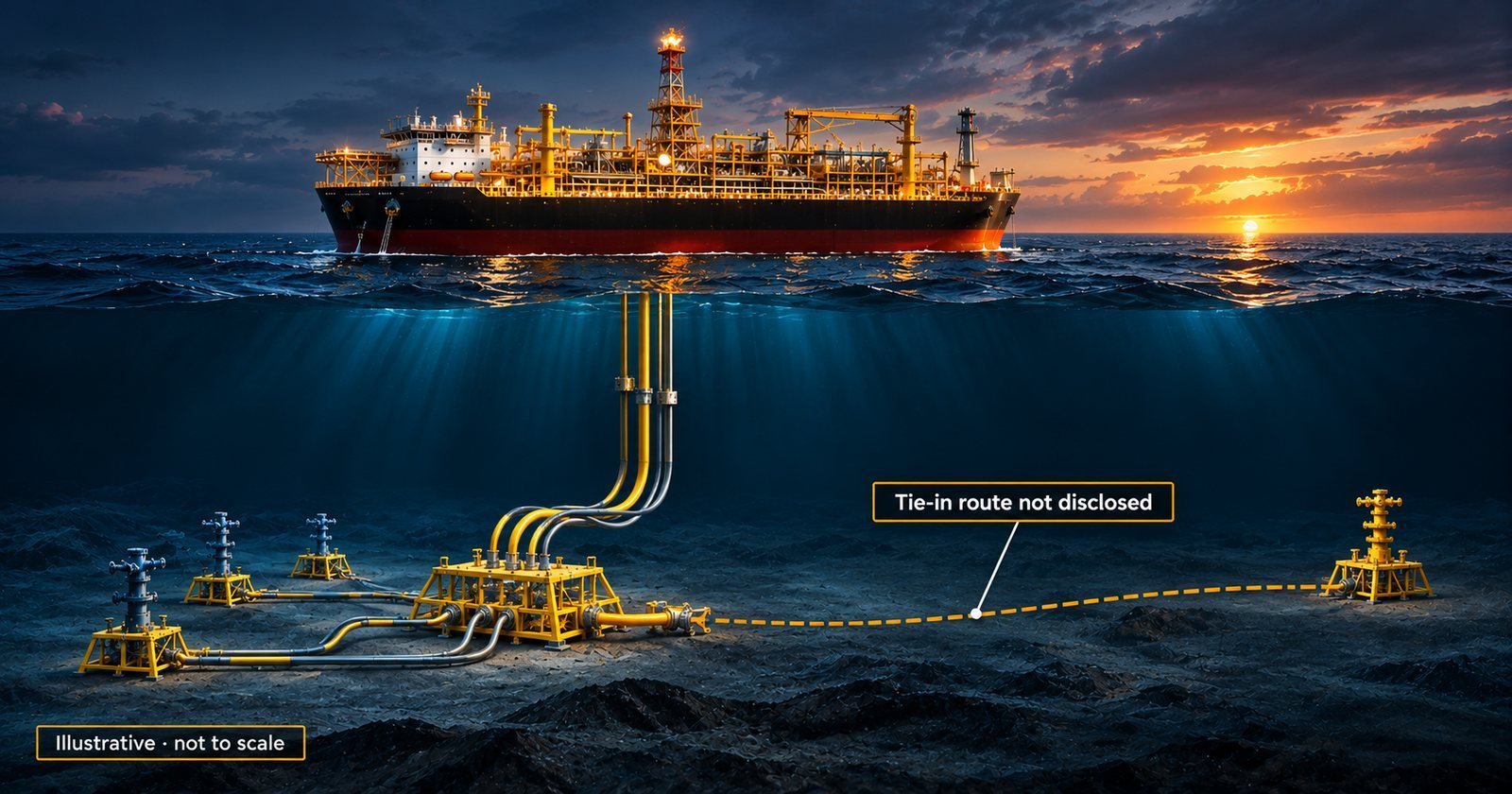
In general terms, a near-field tieback like this needs three things to move fast:
- Spare capacity on the host. Fifteen years into Pazflor’s life, TotalEnergies says the FPSO has available capacity, so new barrels can flow without new topsides.
- Subsea infrastructure nearby. Nearby subsea infrastructure can dramatically shorten development time if the discovery can be connected with limited new hardware. Public information does not yet disclose Acacia-5’s exact subsea tie-in architecture.
- A well that can produce quickly. The biggest drilling question is whether the discovery well itself can be completed as a producer, or whether a new well must be drilled and completed. Public reports do not say which route was taken for Acacia-5.
The expected contribution of about 6,000 b/d is modest compared with a greenfield deepwater development, which helps illustrate the economics of infrastructure-led development: resources that might be difficult to commercialise independently can become attractive when existing facilities have spare capacity.
To be clear about what is not known: TotalEnergies has not publicly disclosed Acacia-5’s subsea configuration, its completion route, its recoverable volumes or its development cost.
03 · My take
The headline sells speed, but I read Acacia-5 as a story about patience. The three months are the visible part. The invisible part is fifteen years of Pazflor infrastructure and operating experience: an FPSO with available capacity and an established subsea production system already serving the area, already installed and operating long before anyone drilled this well. Without an existing host, a discovery like this would face a fundamentally different development schedule and economic threshold. With it, the target becomes a short campaign.
That changes what success looks like on the rig. On a standalone development, the well is one piece of a very long project. On an ultra-fast tieback, well delivery can become one of the critical schedule drivers. There is little room for a slow section, a lost-circulation event or a completion that needs a second run, because delays in well delivery can directly postpone the moment that available host capacity begins generating incremental production. Clean, predictable well delivery matters more than ever.
I think tiebacks and brownfield projects will become an increasingly important part of deepwater Angola’s next decade, alongside the larger greenfield developments that still move forward, around hubs like Pazflor, Dalia and CLOV. The rigs and crews that do well will be the ones that can plan quickly and drill a well right the first time.
04 · The Angolan angle
Acacia-5 is not an isolated case. In July 2025, Begonia on Block 17/06 started up as five subsea wells tied back to the same Pazflor FPSO, and CLOV Phase 3 came online as four subsea wells tied back to the CLOV FPSO; each was sized at 30,000 barrels per day, about 60,000 in total, and TotalEnergies described both as using ullage, or spare capacity, on existing FPSOs (TotalEnergies; JPT). The two new blocks, 17/25 and 32/21, follow the same logic: TotalEnergies itself cites their proximity to six producing FPSOs as a route to future tiebacks.
Angola’s total liquid-fuels production fell from about 1.8 million b/d in 2014 to about 1.2 million b/d in 2023, as mature fields declined and upstream investment slowed (EIA). In that context, this hub strategy can keep existing infrastructure productive for longer and improve utilisation of available FPSO capacity. If this hub-led development model expands, Angolan drilling and completions teams are likely to see more short-cycle campaigns built around existing infrastructure, where planning speed and well delivery matter as much as the geology.
05 · What to watch next
- The key question: TotalEnergies announced a three-month discovery-to-production target in September. Has that target actually been achieved, and at the expected 6,000 barrels per day?
- The first exploration wells on Blocks 17/25 and 32/21, and whether their prospects are planned from the start as tiebacks to existing FPSOs.
Sources
- TotalEnergies (10 September 2026). Exploration in Angola: TotalEnergies Announces a New Discovery on Block 17 and Enters Two New Exploration Blocks. totalenergies.com
- TotalEnergies (23 July 2025). Angola: Start-up of BEGONIA and CLOV Phase 3 Offshore Projects. totalenergies.com
- TotalEnergies (2011). Angola: Inauguration of Pazflor. totalenergies.com
- U.S. EIA (26 February 2025). Country Analysis Brief: Angola. eia.gov
- Independent cross-checks: JPT (2025), TotalEnergies Boosts Offshore Angola Production by 60,000 BOPD (jpt.spe.org); Oil & Gas Journal (14 September 2026), TotalEnergies finds oil in Angola Block 17 (ogj.com); World Oil (10 September 2026), TotalEnergies fast-tracks Angola oil discovery (worldoil.com)
The views expressed on The Well Log are my own and do not represent those of my current or former employers. All information is drawn from public sources.