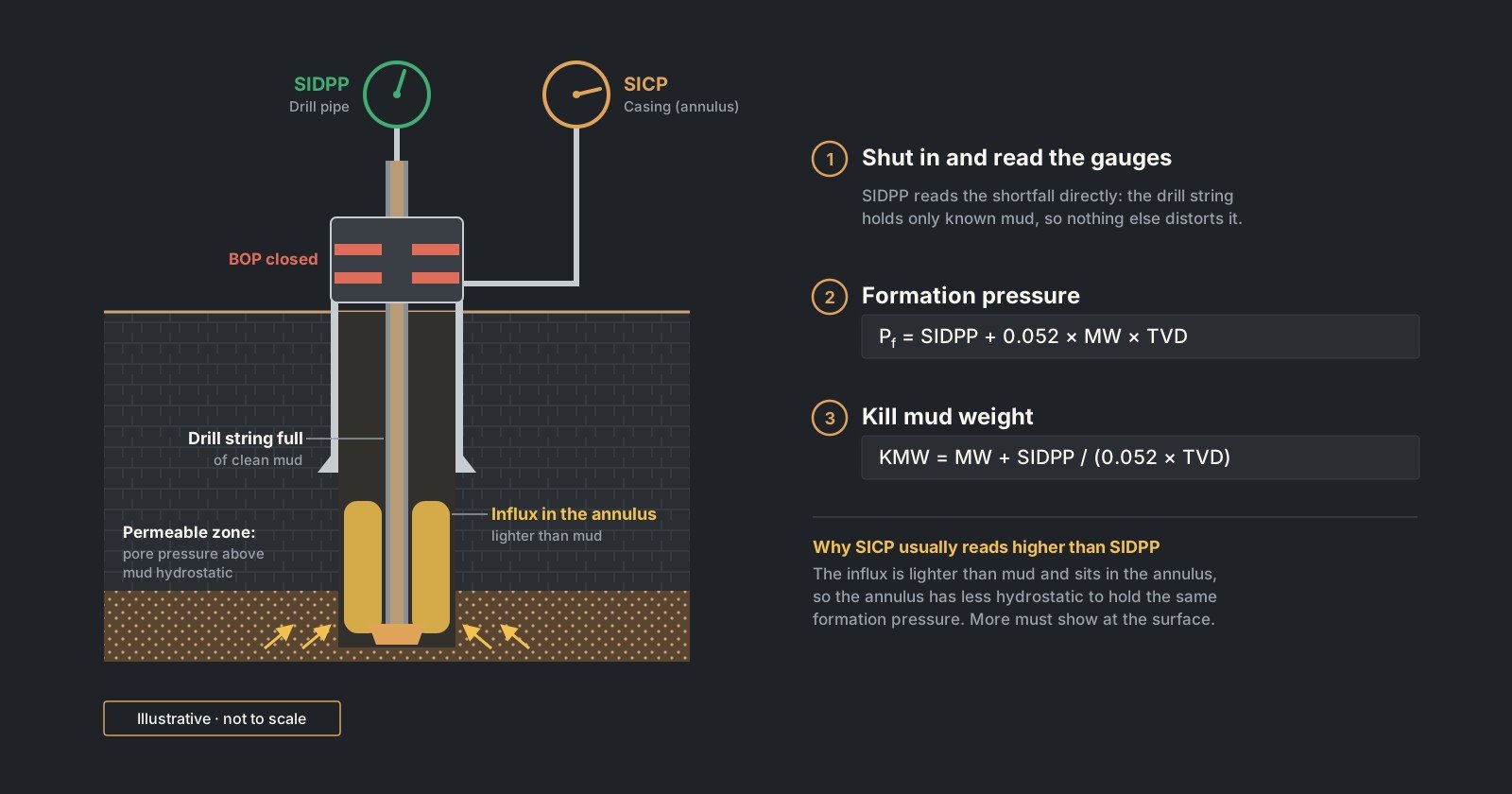
In the previous Drilling Fundamentals article, the mud kept the well under control because its pressure stayed above formation pressure. This article looks at what happens when it does not: formation fluid enters the well, the well is shut in, and the resulting surface pressures help diagnose the event. SIDPP is then used to calculate the kill mud weight.
In this article
1. What a kick is, and why it happens
A kick is an unintended influx of formation fluid into the wellbore when formation pressure exceeds the effective wellbore pressure at a permeable interval. In conventional static conditions, that usually means the hydrostatic pressure of the mud is insufficient. If it is not controlled, a kick can escalate into a blowout (SPE PetroWiki, Kicks).
The same source lists the usual causes (PetroWiki):
- Insufficient mud weight, the predominant cause.
- Improper hole fill-up during trips, which lets the mud level, and therefore hydrostatic pressure, fall.
- Swabbing when pulling pipe, which temporarily reduces bottomhole pressure (see surge and swab in the glossary).
- Gas-cut mud, which lowers the density of the mud, although gas expansion is concentrated in the shallow part of the annulus, so the effect on bottomhole pressure is usually smaller than the surface density suggests.
- Lost circulation, which shortens the mud column.
Every one of these comes back to the same idea from the previous article: wellbore pressure has fallen below formation pressure in a permeable zone.
2. Warning signs
PetroWiki groups kick warning signs into primary and secondary indicators (PetroWiki):
| Primary indicators | Secondary indicators |
|---|---|
| Flow rate out increases while pumping at a constant rate | Pump pressure decreases while pump strokes increase |
| Pit volume increases with no surface transfer to explain it | String weight increases, as lighter formation fluid reduces buoyancy |
| The well flows with the pumps off | Drilling break: a sudden increase in rate of penetration |
| Improper hole fill-up on trips | Gas-cut mud at the flowline |
Not every sign proves a kick; some only warn of a possible one, and several have other explanations, such as a washout in the drill string. Suspected indicators are handled according to the operator’s well-control procedure; where appropriate, a flow check is used to determine whether the well is flowing, and a confirmed influx requires prompt shut-in.
3. Reading the shut-in well: SIDPP and SICP
Once the well is shut in and the pressures stabilise, two surface gauges matter:
- SIDPP, the shut-in drillpipe pressure, read on the drillpipe side.
- SICP, the shut-in casing pressure, read on the annulus side through the choke manifold.
The pressure at the bottom of a shut-in well is the hydrostatic pressure of the fluid column plus any additional pressure applied at the surface (SLB Energy Glossary, SIBP). The key insight is that the drill string is still full of mud of known density, while the annulus now contains an unknown mixture of mud and influx. The drillpipe side therefore acts like a bottomhole pressure gauge (PetroWiki), and formation pressure can be calculated from it:
Pform (psi) = SIDPP (psi) + 0.052 × MW (ppg) × TVD (ft)This is the standard field relationship (Lapeyrouse, Formulas and Calculations for Drilling, Production and Workover). This simple U-tube relationship assumes the drill string contains mud of known, reasonably uniform density and that a representative, stabilised SIDPP can be obtained. Float valves, changing mud density or the bit being away from the influx zone can require additional interpretation.
For the standard on-bottom calculation, TVD is the true vertical depth of the bit at the kicking formation. If the bit is significantly above the influx zone, the simple formula requires additional analysis.
What about SICP? SICP is usually higher than SIDPP when the annulus contains influx lighter than the mud, because the annulus column weighs less. The difference between the two carries information about the influx, but SICP does not appear in the kill-mud calculation. A high casing pressure does not, by itself, mean a high kill mud weight (PetroWiki). That does not make SICP unimportant: it is critical for monitoring annular pressure, controlling the choke and keeping the kill operation within allowable pressure limits.
4. Kill mud weight
The kill mud weight is the density that makes the hydrostatic pressure of the drill-string column equal to formation pressure. Rearranging the equation above:
KMW (ppg) = MW (ppg) + SIDPP (psi) / [0.052 × TVD (ft)]PetroWiki writes the same equation with 19.23 in place of 1/0.052 (PetroWiki), and the IADC WellCAP well-control worksheet uses the same calculation from SIDPP, TVD and the present mud weight (IADC). This is the base value: it contains no trip margin or safety margin, and it ignores circulating friction. The calculated value is then handled according to the operator’s approved rounding and safety-margin procedure; any added margin must remain within the allowable pressure window.
Worked example 1: the PetroWiki case
A well is shut in with SIDPP = 240 psi, the bit at 11,550 ft TVD and 12.1 ppg mud in the string.
- 0.052 × 11,550 = 600.6 psi per ppg.
- 240 / 600.6 = 0.40 ppg.
- KMW = 12.1 + 0.40 = 12.5 ppg, which matches the published result (PetroWiki).
Worked example 2: back to our 10,000 ft well
The well from the previous article was drilling with 10.5 ppg mud at 10,000 ft TVD, with a fracture pressure of 5,820 psi (11.19 ppg EMW). For this arithmetic example only, assume that 5,820 psi limit applies at the same 10,000 ft TVD. In a real well-control calculation, the critical pressure limit would normally be evaluated at the weakest exposed formation, often near the previous casing shoe. Suppose the bit drills into a zone with higher pressure than planned, the well kicks and is shut in with SIDPP = 300 psi.
- Formation pressure: 300 + (0.052 × 10.5 × 10,000) = 300 + 5,460 = 5,760 psi, or 5,760 / 520 = 11.08 ppg EMW.
- Kill mud weight: 10.5 + 300 / 520 = 10.5 + 0.58 = 11.08 ppg. For this example, take 11.1 ppg.
- Static pressure with kill mud: 0.052 × 11.1 × 10,000 = 5,772 psi.
- Margin to fracture at that depth: 5,820 − 5,772 = 48 psi.
The well can be statically balanced, but only just. The kill operation must also control the pressure profile while the influx is circulated out. Pump friction, influx migration and choke pressure affect pressures throughout the system, especially at the casing shoe and at surface. The choke is therefore managed to maintain the required bottomhole pressure without exceeding the allowable pressure at the weakest exposed formation. This is why engineers check kick tolerance and the strength of the weakest exposed formation before a section is drilled, a topic for a later article in this series.
5. From calculation to the rig floor
Kill-weight mud has to be available quickly. It is usually made by weighting up mud already in the system or in storage with a weighting material such as barite or hematite, and a pilot test is recommended to check whether the heavier mud will need dilution to remain pumpable (SLB Energy Glossary, Kill-weight fluid).
The influx is then circulated out of the well under control through the choke, using an established well-control method and the rig’s kill sheet. Those methods deserve their own article; the point here is that, for conventional circulating kill methods, SIDPP and the calculated kill mud weight are two of the key starting values.
Quick reference
| Quantity | Formula (oilfield units) | Units |
|---|---|---|
| Formation pressure (shut in) | SIDPP + 0.052 × MW × TVD | psi |
| Formation pressure as EMW | Pform / (0.052 × TVD) | ppg |
| Kill mud weight | MW + SIDPP / (0.052 × TVD) | ppg |
| Same, PetroWiki form | SIDPP × 19.23 / TVD + MW | ppg |
Try it yourself
A well is drilled with 9.8 ppg mud. The bit is at 8,500 ft TVD when the well kicks. After shut-in, the pressures stabilise at SIDPP = 350 psi and SICP = 520 psi.
- What is the formation pressure?
- What is the formation pressure as an equivalent mud weight?
- What is the kill mud weight, to one decimal place?
- If the weakest exposed formation can withstand 10.9 ppg EMW (assume, for simplicity, at the same depth), what static margin remains with the kill mud?
- Why is SICP higher than SIDPP, and why is it not used to calculate kill mud weight?
Answers
- 350 + (0.052 × 9.8 × 8,500) = 350 + 4,332 = 4,682 psi.
- 4,682 / (0.052 × 8,500) = 4,682 / 442 = 10.59 ppg EMW.
- 9.8 + 350 / 442 = 9.8 + 0.79 = 10.59 ppg, or 10.6 ppg to one decimal place.
- 10.9 − 10.6 = 0.3 ppg, or 0.3 × 442 ≈ 133 psi of static margin. In a real kill, the pressures during circulation would also have to be checked against this limit.
- The annulus contains influx lighter than the mud, so its column weighs less and more surface pressure is needed to balance the formation. Because the influx density and height are uncertain, the annulus does not provide the same direct, known-density hydrostatic reference as the drill string, which is full of mud of known density.
Key takeaways
- A kick occurs when wellbore pressure falls below formation pressure in a permeable zone; insufficient mud weight is the most common cause.
- Flow increase, pit gain, flow with the pumps off and improper hole fill are the primary warning signs; suspected indicators are handled according to the operator’s well-control procedure, often starting with a flow check.
- With the well shut in and the standard U-tube assumptions satisfied, the drillpipe pressure provides a practical route to estimating formation pressure: SIDPP plus the hydrostatic pressure of the mud in the string.
- Kill mud weight adds SIDPP, converted to ppg at the bit’s TVD, to the current mud weight. SICP does not enter that calculation but remains critical for choke control and annular-pressure limits.
- Kill mud weight, and the pressures applied during the kill, must stay within the limit of the weakest exposed formation, which is why kick tolerance and shoe strength are checked before a section is drilled.
The views in this article are my own and are based on public sources and general industry practice. The worked examples use illustrative numbers and do not describe any specific well. This article is educational and is not a substitute for well-control training, certification or the operator’s procedures.
Sources
- SPE PetroWiki. Kicks. petrowiki.spe.org
- SLB Energy Glossary. SIBP (shut-in bottomhole pressure). glossary.slb.com
- SLB Energy Glossary. Kill-weight fluid. glossary.slb.com
- IADC. IADC WellCAP Well Control Worksheet, Surface Stack: Wait and Weight Method. iadc.org
- Lapeyrouse, N.J. (2002). Formulas and Calculations for Drilling, Production and Workover, 2nd edition. Elsevier. Kick analysis section via GlobalSpec